10 Dumbest Decisions In Disaster Movies
If you were in a disaster movie, which of these things would you avoid doing?

Part of the grim entertainment value of disaster movies is in the shock of seeing characters being sacrificed in increasingly startling ways. Typically, the more developed a character feels to the audience, the more shocking it is when they suddenly perish, but that is not always the case.
That's because the genre is filled with leading actors diving into flooding sewers to save their onscreen spouses or handing over imperilled children before taking a swan dive out of a precariously dangling lift. What I'm saying is these films are also filled with characters who make the most blatantly stupid decisions imaginable.
Whilst some of these choices may be quite entertaining at times, at others they can challenge the realms of believability and be more annoying than diverting. Moreover, as disaster films are frequently based on real-life events - from the sinking of grand ocean liners to aeroplanes becoming stranded on snowy peaks - the fact that the protagonists often take the worst route possible in trying to resolve their dilemma is all the more worrying.
Take a look at some of the dumbest decisions ever made in disaster films.
10. The Day After Tomorrow (2004) - Going Outside Despite Warnings

In Roland Emmerich's most notable film since Independence Day (1996), Earth is exposed to extreme weather conditions culminating in a new ice age, which is ushered in through a storm system that freezes everything within its eye.
This is all predicted by American paleoclimatologist, Jack Hall (Dennis Quaid), but surprisingly few people (even in scientific circles) believe him. After a storm surge floods New York City, his son, Sam (Jake Gyllenhaal) is faced with a similar problem when the majority of the survivors sheltering with him in the New York Public Library decide to go it alone, despite Sam's warnings that the weather will get colder, killing those outside.
Unfortunately, Sam is later proven right when Jack and his colleague, Jason Evans (Dash Mihok) discovers that those survivors have frozen to death, underlining just how dumb it was not to follow a little friendly (and professional) advice.
9. Titanic (1997) - Locking Passengers In The Lower Decks

This next entry is based on the real-life sinking of the R.M.S. Titanic in 1912.
Those travelling in steerage were housed in the lower reaches of the ship and priority was given to first and second class passengers to access the lifeboats when the magnificent liner started to sink. The third class passengers were held at bay by padlocked gates that lead to the higher decks before finally forcing their way through. However, after they had gone, the gates were locked again.
Jack Dawson (Leonardo DiCaprio) is being held in the brig for a crime that he did not commit when Rose DeWitt Bukater (Kate Winslet) risks her life to head below decks and release him. However, this means that they then become trapped in the steerage section of the ship whilst it rapidly fills with icy water.
Eventually obtaining the keys to the gate from a guilt-ridden officer (who drops them in the frigid waters), Jack and Rose manage to escape up onto the main deck.
However, locking people in like cattle to prevent them from reaching safety before those of higher social station and then relocking the gates to prevent any stragglers from reaching safety was never a good idea!
8. Earthquake (1974) - Getting In An Elevator
When disaster strikes, never, ever get into a lift - it just isn't a good idea!
This is perhaps best demonstrated in Earthquake, in which major tremors hit Los Angeles. The audience follows a handful of characters, including the occupants of an office building which is severely affected by the earthquakes.
The office workers panic, shoving each other out of the way and fleeing for the nearest lift. Shortly after the doors close, the lift judders and an aftershock disables both the electricity supply and the brakes, sending it plunging down the shaft. Although it is a bit shaky by today's standards, the infamous animated spray of blood that follows, showing us that the occupants are no more, is still quite disturbing.
This was a notoriously difficult scene to film, with two attempts involving fake blood filmed several weeks apart having failed. Ultimately, director Mark Robson decided to use an animated sequence to get over the problem.
7. Snakes On A Plane (2006) - Feeding The Snakes

Adopting the tried and tested aircraft-in-peril premise, Snakes on a Plane became a well-loved film purely for taking a knowingly madcap approach.
One of the film's most memorable but ultimately pointless moments comes when ill-tempered British businessman, Paul (Gerard Plunkett) hurls a Chihuahua at a giant boa constrictor, believing that that will satisfy the serpent's hunger. Soon afterwards, the slimy snake binds itself around Paul himself, suffocating him and distending its jaw to swallow him whole.
When Agent Neville Flynn (Samuel L. Jackson) later shoots out the windows of the stricken Boeing 747 to get rid of the snakes, the boa constrictor also gets sucked out, hurtling by with Paul's legs still hanging out of its mouth.
Even though it is poor compensation for the loss of her Chihuahua, the dog's owner, Mercedes Harbont (Rachel Blanchard) gets the satisfaction of knowing that Paul got his comeuppance in the end.
6. Daylight (1996) - Turning On The Specialist

When disaster strikes, the survivors often descend into the blame game and this is precisely what happens in this Rob Cohen film.
After a tremendous explosion causes a tunnel under New York's Hudson River to collapse, those commuters who have not perished are left to fend for themselves against fires, faulty electrics, and rising freezing floodwaters. When former Emergency Services Chief, Kit Latura (Sylvester Stallone) arrives, they firstly think they are saved.
However, when they discover that they cannot escape through the air duct that Latura used to get in, the survivors soon set upon him, recalling his past failings when he was in service, whilst also turning on each other.
Steven and Sarah Crighton (Jay O. Sanders and Karen Young) are amongst the worst of his assailants and it actually takes the onset of further dangers for them to finally understand that, like it or not, Latura is their only hope.
5. The Cassandra Crossing (1976) - Not Stopping The Train
In order to contain a deadly virus, extreme and freedom-restricting measures sometimes have to be taken including, in this instance, imprisoning passengers onboard an intercontinental train so that the contagion cannot spread.
However, the U.S. military is also keen to contain the idea that the virus ever existed, since the government created it. A host of soldiers therefore board the train at Nuremberg to escort it into Poland across a rusting, dilapidated bridge - the Cassandra Crossing - exposing themselves to danger as well.
Even though brilliant neurosurgeon, Jonathan Chamberlain (Richard Harris) discovers that the pure oxygen that the army pumped into the train in Nuremberg is actually killing the virus, the army officials still refuse to stop the train as it trundles along towards the unstable bridge.
Although this leads to an entertainingly desperate climactic gunfight onboard the train, the army officials are sent to their doom as well, begging the question of why they even boarded the train in the first place.
4. Airport '77 (1977) - Not Being A Team Player
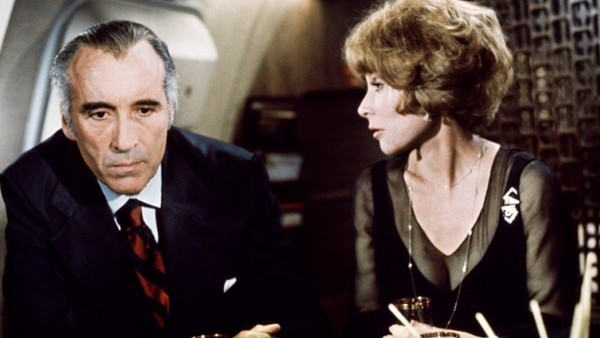
Getting to know your fellow survivors too well can be troubling in a disaster movie, but actively insulting them and isolating yourself from them can be even worse!
Karen Wallace (Lee Grant) fails to achieve this fine balance in the third Airport film. Even before disaster strikes, Karen becomes a nightmare (admittedly a hilarious one) not only to her beleaguered husband, Martin (Sir Christopher Lee) and his assistant, Frank Powers (Gil Gerard), but also the rest of the unsuspecting passengers embarking on the doomed Flight 23.
Things get even worse after the luxurious plane crashes into the ocean in the Bermuda Triangle, as Karen threatens to flood the submerged fuselage just so that she can get out.
Even though her fellow passengers stop her, when the inevitable tidal wave eventually tears through the sunken airliner, no one is really upset to see that Karen is one of the first passengers to be swept to their death.
3. Independence Day (1996) - Holding An Alien Welcome Party
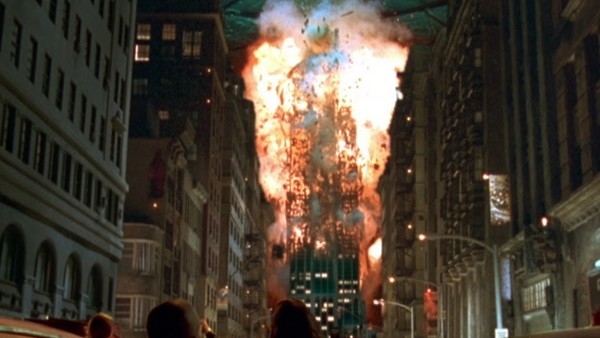
Roland Emmerich's Independence Day spans many genres but, in the sequences in which the alien invaders start their wholesale destruction of Earth, audiences are plunged straight into disaster mode.
Just prior to this, numerous people actually believe that the sinister-looking spaceships have arrived for peaceful purposes, including Tiffany (Kiersten Warren), a friend of Jasmine Dubrow (Vivica A. Fox). Tiffany joins others atop the Bank Tower in Los Angeles, inviting the aliens to make themselves at home, mere minutes before a spaceship decimates it with its destructive laser beam.
The First Lady, Marilyn Whitmore (Mary McDonnell) hesitates in abandoning Los Angeles, stunned by the sight of the aliens and of those welcoming them, which means that her helicopter gets caught in the subsequent firestorm, ultimately costing her her life and those of her aides as well.
2. The Towering Inferno (1974) - Overloading The Breeches Buoy
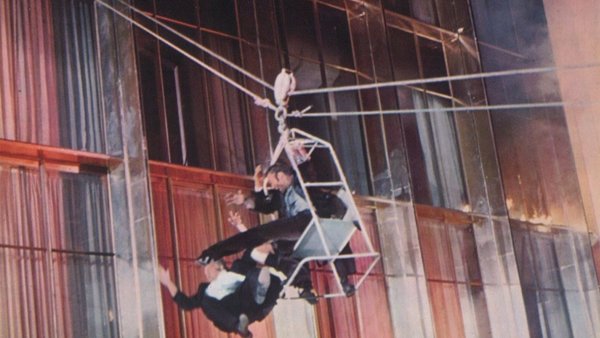
Perhaps the second best known disaster film, The Towering Inferno explores the pure terror of being trapped inside a massive burning building.
After panicked partygoers flood onto the helipad of The Glass Tower, causing a helicopter to crash on it, the San Francisco Fire Department sets up a breeches buoy as an alternative means of winching them down one by one (albeit a far slower one).
When Roger Simmons (Richard Chamberlain), the electrical engineer whose corner-cutting caused the fire, insists on going next on the breeches buoy, an angry mob tries to stop him, clinging to the winch-and-wire apparatus even as it sets off with Simmons aboard. Even Senator Gary Parker (Robert Vaughan) attempts to stop Simmons from descending, only to be shoved to his death by the madman.
Ultimately, due to being overloaded with too many people trying to escape, the entire thing fails and it all collapses, taking the dishonest and murderous Simmons to his well-deserved fate... as well as some of the honest people who tried to stop him.
1. The Poseidon Adventure (1972) - Waiting For Help
This last entry deals with a combination of logic and physics.
The premise of a cruise liner being turned upside down in The Poseidon Adventure is one of the most famous disaster film set-ups of all time.
After the S.S. Poseidon capsizes, Reverend Frank Scott (Gene Hackman) tries to convince the survivors to go with him to the hull of the ship, which is now the top of the ship, but the ship's purser (Byron Webster) opposes him and persuades the majority of the passengers to stay put and wait to be rescued.
Scott knows that this is a mistake, as the ship's ballroom is an air pocket that will soon burst and flood. Shortly after Scott and his party leave, this actually happens and, even though Scott still tries to save some of the passengers that declined his help, his efforts are futile.
Watch Next
How Well Do You Remember JAWS?
