10 Debated Movie Cliffhangers That Have Actual Answers

10. Did Ofelia Imagine Everything? - Pan's Labyrinth
 The Cliffhanger: Guillermo del Toro's undisputed masterpiece Pan's Labyrinth takes place in the Francoist period following the Spanish Civil War, as young Ofelia discovers a hidden labyrinth which leads her on a wondrous, often dangerous adventure with mystical creatures. Del Toro smartly shoots the film in a manner that asks people to make a choice - is Ofelia imagining this fantastical landscape as a means of retreating from the violent post-war horrors around her, or is it for real? The Answer: Though the fantasy theory would make the film a potent allegory, Del Toro himself spilled the beans by declaring in an interview that there were three clues as to Ofelia's adventure being real; a flower unfolding at the end of the film; the fact that Ofelia, in reality, would have been unable to escape the attic, but using her chalk door (which we see another character, Mercedes, notice), she was able to; and finally, that when Ofelia reaches a dead-end while being chased by her stepfather, she has no seeming means of escape - Del Toro posits that the walls open up for her. There you go, straight from the horse's mouth; Del Toro has flat-out said, "I stand in that it's real...There are clues that tell you where I stand and I stand by the fantasy...Those are objective things if you want."
9. What The Hell Did We Just Watch? - Donnie Darko
 The Cliffhanger: To be fair, Donnie Darko is one big WTF, and its cult status is in many ways defined by the fact that nobody really seems to know for sure what it all means. The movie, about a high-schooler outcast named Donnie Darko (Jake Gyllenhaal) who encounters a series of bizarre doomsday visions, involves subjects such as time travel and parallel universes, yet Richard Kelly intentionally keeps the film's explanation extremely vague. The Answer: Richard Kelly actually did compile parts of the fictional book that appears in the film, The Philosophy of Time Travel, and this goes a way to explaining quite what we saw. In layman's terms, on October 2nd, a Tangent Universe (the world we see in the film) is created by an unexplained temporal blip, just before the appearance of the jet engine in the movie (called the Artifact), which kick-starts a causal 28-day time loop. The Tangent Universe is unstable and threatens to destroy the Primary Universe, and it can be rectified by the so-called Living Receiver, Donnie. Anyone who dies in the TU becomes The Manipulated Dead (the guy in the grotesque rabbit suit, Frank, and Gretchen), with a subtle ability to manipulate the Living Receiver, while any living people are subconsciously urged to help Donnie accomplish his destiny, which is to die by the hand of the Artifact and bring things full circle. Hence, the jet engine killing Donnie at the end of the film destroys the TU and restores order to the Primary Universe, where Gretchen and Donnie had never met. Or something. Alright, that was a mouthful, but at least Kelly bothered to try and explain himself, even if he ultimately raised more questions...
8. What Happened To Neo? - The Matrix Revolutions
 The Cliffhanger: The Matrix Revoltions ends with Neo (Keanu Reeves) making a deal with a literal Deus ex Machina, for the machines and Zion to form a truce if Neo can help obliterate Agent Smith. Smith is destroyed with their co-operation, and Neo's code is seemingly returned to the source for "dissemination". Whatever that means. The Oracle alludes to the fact that they'll probably see Neo again one day, and the movie ends. The Answer: The video game The Matrix Online extends the mythology of the series post-Revolutions, and though the title was mostly panned by critics, it did at least offer a lifeline for those desperate to know what happened next. Following Neo's death, there was an urgent dash to collect the fragments of Neo's "residual self-image" (how he appears to others in The Matrix), while Morpheus tried to get Neo's physical remains returned to Zion, despite the Sentinels claiming that they did not have them. After Morpheus was killed, there were reports of messages coming from someone claiming to be Morpheus, who also asserted that Neo was not dead either. The game ended in 2009 with it unclear as to whether the Sentinels still had Neo or not, and so short of a fourth Matrix movie - which would probably disregard this continuity anyway - that's as good as we're going to get.
7. Does Randy Die In The Final Shot? - The Wrestler
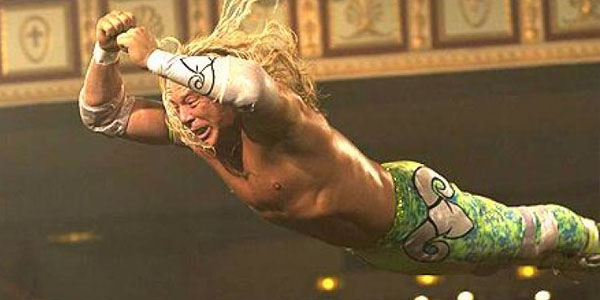 The Cliffhanger: The final scene of the movie has Randy "The Ram" Robinson (Mickey Rourke) suffering from chest pains during a fight - a result of his earlier heart attack, where he was advised not to wrestle again - and this pain reaches an apex as he climbs the turnbuckle to perform a flying splash. Realising that his only real prospect at a happy life (Marisa Tomei) has left, he dives off, and the screen cuts to black. Did Randy die, or not? The Answer: In an interview, Aronofsky confirmed that Randy dies, attesting, "I think just like him so much. But it's pretty obvious what's going on." After the interviewer suggested that Randy died happy, doing what he loves, Aronofsky agreed with this sentiment. Simple.
6. What Did Bill Murray Whisper At The End? - Lost In Translation
 The Cliffhanger: Sofia Coppola's hugely acclaimed drama has Bill Murray playing a downtrodden actor named Bob who comes across Charlotte, a young girl who is herself expressing doubts over her marriage. Over the course of the film, Bob begins to fall for Charlotte, but when he has to fly back to the States, he embraces her one last time and whispers something inaudible in her ear, leaving us to ponder what exactly was said. Did he tell her to meet him at a given location on a given day, Before Sunrise style? Or did he give her a piece of sage advice? The Answer: Bob's utterance doesn't appear in the film's script because Sofia Coppola wanted Murray to improvise the line, but it does state that Bob wants to tell Charlotte how in love with her he was, yet relents, finding himself unable to. However, the real answer didn't come from anyone related to the production, but some net nerds using audio manipulation software; they discerned that while the first part of the sentence is hard to hear, Bob probably ended by saying, "...go to that man and tell him the truth, OK?" What does that mean? Is he talking about Charlotte's husband, John? Or another man she might get with in the future? Until this recording surfaced, most assumed that Murray probably didn't actually physically say anything on the film's soundtrack, so while the meaning may not be clear, it is within the DNA of the film, rather than some fancy that we're left to ponder forever more.
5. Does The Iron Giant Remember Hogarth? - The Iron Giant
 The Cliffhanger: The Iron Giant is about an amnesia-riddled robot who makes friends with a 10-year-old boy named Hogarth, and at the end of the movie, the robot sacrifices himself to save the town, being blown to bits. However, the final scene of the film has the pieces, scattered in Iceland, reforming, at which point we see the robot's eyes flash on and it smile. Does the robot remember Hogarth, or has it had another memory wipe? The Answer: Looking at all the facts, it's unlikely. Despite the flowery tone of those final moments, you have to remember that the robot was sent to Earth by something, and it's only the crash landing that allowed its memory to be erased and for Hogarth to work his way into its metal heart. Needless to say, if that crash landing erased his memory, then the nuclear blast sure will have, and though Hogarth could simply go through the same shtick with him all over again, it's equally possible that the Iron Giant would just kill him. Given that his rampage would begin in Iceland, it would give him plenty practice at being badass once again. Backing this up is a deleted scene, in which the Giant has a memory of himself and other robots laying waste to another planet, making it clear that the bot is intended as an instrument of destruction rather than a saviour.
4. Why Did Dave Turn Into The Star Child? - 2001: A Space Odyssey
 The Cliffhanger: 2001: A Space Odyssey ends with the protagonist, Dave, seemingly turning into the so-called Star Child, a gigantic baby who sits in space, staring down at Earth. Um, what? The Answer: Kubrick co-write the script with renowned sci-fi writer Arthur C. Clarke, and it actually does explain what the Hell we just saw. Originally, these scenes had a voiceover attached, but Kubrick, in typically provocative fashion, decided to remove it to blow our minds that little bit more. Basically, remember the monoliths that we saw with the apes at the start of the movie? They are actually machines devised by advanced aliens to speed up human evolution. Thus, at the end of the movie, when Dave interacts with a monolith himself, it has simply turned him into an extremely evolved form of human being, the Star Child seemingly being the zenith of humanity's potential.
3. Is Cobb Still Dreaming? - Inception
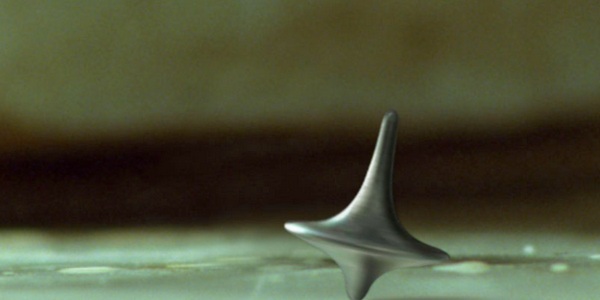 The Cliffhanger: Inception ends on a real kicker of a cliffhanger, as Cobb (Leonardo DiCaprio) seemingly returns home to his children, spinning the totem one last time before leaving to play with them. He doesn't see whether the totem falls or not, and the movie ends with the totem wavering, but not falling, implying that Dom could still be in a dream. The Answer: Director Christopher Nolan doesn't care to talk about the physical, binary truth of the ending, but more so the philosophical truth of it, that if you're left dying to know if Dom made it back to reality or not, you've sort of missed the point of the movie. Nolan himself said, "The real point of the scene and this is what I tell people is that Cobb isn't looking at the top. He's looking at his kids. He's left it behind. That's the emotional significance of the thing." That's precisely it; Cobb has chosen to accept whatever reality he is being presented with, which in essence is far more important than where he actually is. For better and possibly for worse, he has allowed himself to let go.
2. What Was Real And What Wasn't? - Mulholland Drive
 The Cliffhanger: David Lynch's unequivocal surreal masterpiece is known for being immensely vague from first frame to last, concluding with the main character, Diane Selwyn (Naomi Watts), shooting herself in the head after experiencing an extremely disturbing hallucination. The Answer: Everything leading up to that is intentionally ambiguous, what with Watts and Laura Harring playing different characters for the first half of the movie. Still, there's a fair consensus among film critics and scholars that the oddball first half is simply a dream sequence that Watts' Diane concocted in her mind following her failure to become a Hollywood star. The second half depicts Diane as her sanity begins to unravel, and her obsession with Camilla Rhodes (Harring) reaches its apex. Realising that she can never be with Rhodes, she takes her own life. The first half is a dream; the second half is the dark reality. Simple.
1. Is Deckard A Replicant? - Blade Runner
 The Cliffhanger: Blade Runner concludes with protagonist Deckard staring at a origami unicorn left for him by Gaff, the implication being that Gaff knows the truth; Deckard is also a replicant. Replicants have none of their own memories, so they all share similar implanted memories, and by Gaff seeming to know what Deckard is thinking, it implies that Deckard's thoughts are not his own, and he is a replicant. The Answer: The answer is extremely simple; Ridley Scott said in an interview with Channel 4, "He's a replicant". However, both on set and since, Harrison Ford has rejected that claim, as has one of the movie's screenwriters, Hampton Fancher. This raises an interesting question about the idea of ownership; who really "owns" the story when ambiguities are concerned? We so often attribute this responsibility to the director, but it's Harrison Ford who lived and played the character, and Scott didn't write the thing. The straight-forward answer is that, given that this is Ridley Scott's overarching vision and interpretation of the screenplay that, yes, Deckard is a replicant, as much as others might try to get their oar in and argue otherwise. What do you think of these debunked cliffhangers? Can the answers ever be seen as truly canon? Care to disagree? Let us know in the comments below.