10 Best Anti-War Movies

War... the ultimate shame of mankind.
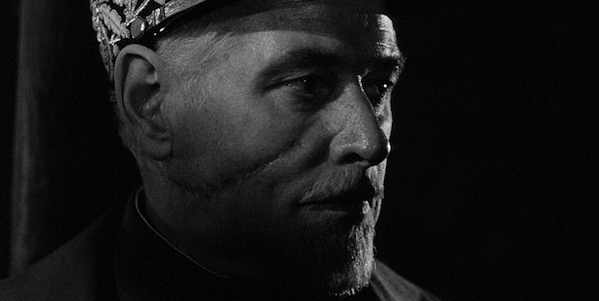
War... ever present throughout most of history, it is the ultimate shame of mankind, an expression of our most violent and destructive impulses on a grand scale, capable of destroying civilizations and reshaping the global map. Instigated by the elites - the royalty, politicians, businessmen and financiers who often profit from it - it is fought by the common man, the disposable masses flung into the firing line as pawns in a game of chess. Depictions of warfare in cinema have ranged from jingoistic, patriotic propaganda movies, in which the good guys and their enemies are simplistically represented and the cause is always just and noble, to more nuanced meditations on the effects of warfare on mankind. Stanley Kubrick's 1957 masterpiece starring Kirk Douglas, Paths of Glory, is re-released in cinemas this week, and remains a powerful anti-war treatise on the folly and hubris of World War 1 in which arrogant commanding officers forced untold thousands to their deaths in the trenches and the no man's land which lay beyond. To mark the return of Paths of Glory to our cinema screens here are 10 of the very best anti-war movies of all time, classic films which bring to light war in all its physical horror and psychological trauma and question the lies and deceptions of those who would wage it.

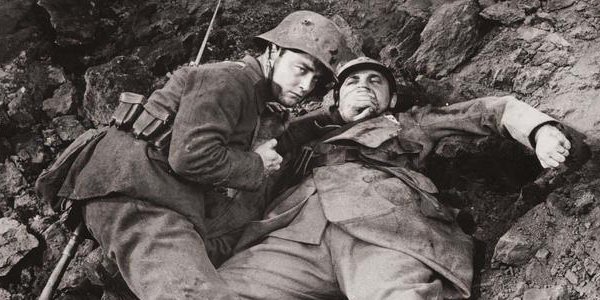
10. All Quiet On The Western Front

In Paths of Glory, Stanley Kubrick examined the First World War from the perspective of the French soldiers who refuse to obey suicidal orders and find themselves defending charges of cowardice in a court martial, facing potential execution. With Lewis Milestone's anti-war classic, All Quiet on the Western Front, the same war is viewed from the perspective of the Germans. Based on the novel of the same name by Erich Maria Remarque, the film follows a group of young German men as they are plucked from village life and trained as soldiers before being sent to the trenches. As the artillery fire rains down and they face death in no man's land, their cheery dispositions as civilians quickly transforms into fear and despair. With battle scenes which still stand up to this day (Kubrick appears to have taken a leaf out of Milestone's book for Paths of Glory) it is a truly powerful work of cinema fully deserving of its status in the Library of Congress' National Film Registry as "culturally, historically, or aesthetically significant." Remarque had fought in the trenches himself, as indeed had a German of a completely different character, Adolph Hitler. When the Nazis came to power, All Quiet on the Western Front was among the many books banned and burned. Inevitably, war-minded leaders are inclined to suppress any work which preaches peace.

9. The Thin Red Line

When Terrence Malick returned from the wilderness and started directing again, The Thin Red Line was his first project. Based on the novel of the same name by James Jones, it depicts the American soldiers in Guadalcanal as they struggle to rout the Japanese from their dug in positions on the tropical island. A notable aspect of The Thin Red Line is Malick's refusal to focus too much on any given character, preferring instead to meander around the soldiers of C Company and explore their various perspectives. While this approach might have led to an obviously disjointed narrative in some hands, Malick is less concerned with a coherent or conventional plot and more with exploring broader ideas of the dehumanising nature of warfare and the juxtaposition with man's inherent violence as a force of nature. Malick's consistent near-metaphysical approach to his subject matter has long divided audiences, and those expecting a war film Hollywood-style are far better served by movies like Saving Private Ryan. The Thin Red Line is also notable for Malick's notorious habit of cutting out performances entirely from the final cut - Billy Bob Thornton, Gary Oldman, Viggo Mortensen and Martin Sheen are among those who failed to make it onto cinema screens.

8. La Grand Illusion

When a filmmaker of the stature of Orson Welles remarks that a film is one he would choose to take "on the ark", it's difficult not to build up expectations of a masterpiece. This is precisely what Jean Renoir's La Grand Illusion amounts to, delivering a message which speaks of the transcendental nature of the human spirit and its ability to break down nationalistic boundaries. Renoir, son of the famous Impressionist painter Pierre-Auguste Renoir, tells the story of two French pilots who get shot down over German-held territory during the First World War and find themselves shuffled from one prisoner of war camp to another, biding their time to escape. Starring Jean Gabin and Pierre Fresnay as the pilots and featuring a dominating performance from Erich Von Stronheim, himself a notable director of the period, La Grand Illusion is all the more powerful given that it was made during a time when fascism was on the rise. La Grand Illusion is an anti-war film which ignores the physical horrors of battle, preferring instead to focus on those on the periphery, either in captivity or on the run amongst civilians. While it concludes with the protagonists setting off to return to the front to fight, it is clear that, for Renoir, war as a philosophy is what should be under attack, and that violence ultimately leads to the collapse of civilization.

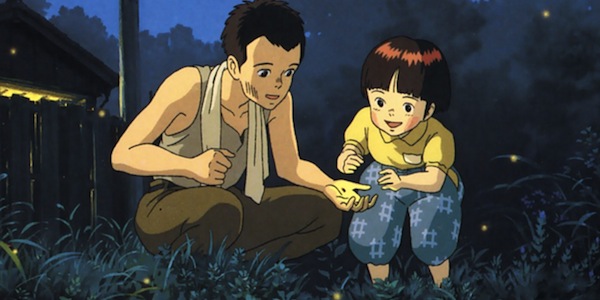
7. Grave Of The Fireflies

War affects people from all walks of life, but the suffering and death of children is the most tragic. World War 2 saw untold devastation wreaked upon the people of Japan, with the death toll from the dropping of two nuclear bombs a fraction of all those who died during the intense fire bombing raids which occurred over the previous years. When people hear the name Studio Ghibli it brings to mind the work of Hayao Miyazaki, the grandfather of Japanese animation and creator of a host of hugely entertaining and memorable family-friendly movies. Ghibli's co-founder (along with Miyazaki) Isao Takahata's 1988 animated adaptation of Akiyuki Nosaka's novel Grave of the Fireflies replaces the wild fantasy for the harsh realities of a society on the edge after the end of World War 2, following siblings Seita and Setsuko as they fight against starvation. Few live action films are as harrowing, moving and ultimately humanistic as Grave of the Fireflies. And while Takahata denies that his intention was to make an anti-war movie, the effects and responses the film elicits suggest that, whatever his intentions, a powerful message about the dreadful consequences of war on civilians is what lingers after the credits have rolled.

6. Ivan's Childhood

Andrei Tarkovsky is hardly a director noted for making lightweight, easy to follow popcorn fare - often his films are rich and dense in symbolic and metaphorical content, with layers of meaning permeating his movies as if tempting the viewer to tease the "truth" out of the motifs and imagery. Despite the non-linear plot and use of flashbacks, Ivan's Childhood is perhaps one of his most accessible works, its comparative simplicity in no way diminishing its power. Ivan is a young orphan boy in war-torn Russia during the Second World War who discovers that his family have been killed by German soldiers and becomes desperate to join the army and fight. Made in 1957, the same year Kubrick made Paths of Glory, for a directorial debut it's a remarkable achievement, with Tarkovsky already demonstrating a knack for poetic imagery and highly imaginative and unconventional narrative style, as Ivan's exploits are interwoven with beautifully composed dream sequences. Praised by everyone from Jean-Paul Satre to Krzysztof Kie›lowski, Ivan's Childhood, like Grave of the Fireflies, views the savagery of war from the perspective of a child, but draws another saddening conclusion, one that speaks of children consumed by vengeance and violence, innocence lost forever.

5. The Great Dictator

Sometimes, the best way to highlight the sheer absurdity of something abhorrent is to make fun of it. With laughter, the most evil and unspeakable acts in the world can be confronted without going insane, and comedy - satire in particular - is often used to hold a mirror up to humanity and reveal all the warts and blemishes. Charlie Chaplin was no stranger to using comedy as a form of social and political commentary, with his tramp character in Modern Times and City Lights standing in for the common man in the face of poverty and oppression. His politics are most evident in his first talking feature The Great Dictator, a wonderfully subversive comedy featuring Chaplin as both a Jewish barber and a dictator called Adenoid Hynkel. When the barber finds himself in the dictator's place, the future of humanity takes an entirely different shape. The closing speech sums up Chaplin's hopes for a future free of war: "We are coming into a new world, a kindlier world, where men will rise above their hate, their greed, and brutality. The soul of man has been given wings, and at last he is beginning to fly. He is flying into the rainbow €” into the light of hope, into the future, the glorious future that belongs to you, to me, and to all of us."

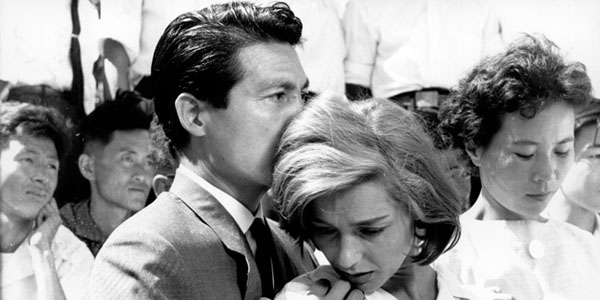
4. Hiroshima, Mon Amour

Post-war Japan is the setting for Hiroshima Mon Amour, Alain Resnais' groundbreaking and lyrical experiment in the language of cinema. It follows a French actress and a Japanese architect they as discuss the nature of memory, both personal and historic. Ushering in the French New Wave, Resnais jumps between the past and the present, the personal and the social, as the two lovers offer their perspectives on their relationship and their past. The imagery frequently juxtaposes ideas and themes - during the war, the actress had her head shaved for sleeping with an German soldier in the occupied French town of Nevers, contrasting with the Japanese women following the dropping of the bomb on Hiroshima losing their hair on account of radiation poisoning. It's both a striking and daring film in its construction, with a looseness of narrative that allows for the exploration of broader ideas. It's also a commentary on the meaningless cultural divisions which war creates, with love transcending boundaries, however fragile and tentative it may be.

3. Full Metal Jacket

Undoubtedly one of the most memorable characters in movie history is Gunnery Sergeant Hartman, the drill instructor played by R. Lee Emery in Stanley Kubrick's second great anti-war movie, Full Metal Jacket. It is a towering performance; a relentless assault on the senses as he drills his recruits into the ground in order to prepare them for the war in Vietnam. Emery was a drill sergeant himself and ad libbed much of the dialogue, with Matthew Modine and Vincent D'Onofrio playing two very different recruits, James "Joker" Davis and Leonard "Pyle" Lawrence. Joker's voice over provides the anchor from which Kubrick's extended study of the brutality of war, and while the combat sequences are somewhat overshadowed by the incredible first act, in which Pyle's mental state crumbles into a psychotic ball of fury, Full Metal Jacket offers a profoundly shocking insight into the brainwashed military mentality and its devastating consequences. One of the most impressive aspects of Full Metal Jacket - besides the incredible performances from Emery and D'Onofrio, who beat Robert de Niro's record for gaining weight for a film with Raging Bull - is the ingenious way in which Kubrick and his production designers managed to transform a run down gas works into war torn Vietnam. Modine and others were less than happy about this - the place was asbestos and hundreds of other chemicals.

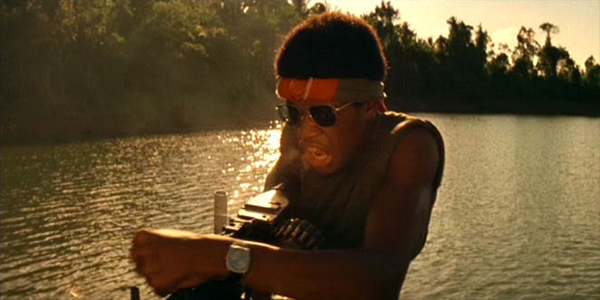
2. Apocalypse Now

It's safe to assume that the US military wasn't about to rush out and offer Francis Ford Coppola their full support when he set out to make Apocalypse Now, his epic masterpiece about the insanity of war and the dehumanization of man in combat. Pentagon approval and assistance, after all, demands that the military is not portrayed in a negative light. Loosely based on Joseph Conrad's incredible book, Heart of Darkness, Apocalypse Now follows Captain Benjamin Willard (an excellent performance from Martin Sheen) as he travels into the depths of the jungle to track down a renegade special forces colonel, Walter Kurtz (Marlon Brando). A film which has achieved legendary status not least because the shoot was as metaphorically grueling as the Vietnam War itself, Coppola depicts war as a near-hallucinatory nightmare, while Kurtz's descent into madness is delivered in one of the most powerful performances of Marlon Brando's illustrious career. It's worth noting that there is something of a debate over whether or not Apocalypse Now is an anti-war film or a pro-war film - advocates of both positions ironically tend to cite the same reason to justify their position: the film's depiction of the brutality of war and the destruction of nature a condemnation of warfare or a celebration of American supremacy, depending on your view. Coppola leaned towards the anti-war perspective then took it a step further, describing it as "anti-life".

1. Come And See

Few actors have managed to portray with facial expressions the true horror and fear which war induces as effectively as Aleksei Kravchenko - and at the time of filming, the 14-year-old who plays the central character Floya who is caught up in the war when partisan fighters arrive at his village and take him away to fight the German army. Come and See is a truly stunning slice of cinema which marries the perspective on war from the perspective of someone who isn't yet an adult with the delirious violence of Coppola's Apocalypse Now while throwing in a finale which stuns with its inventive use of imagery, conveying the unfurling of history and the inevitability of the destructive forces of war under fascism. Director Elem Klimov is a director of bravura talent deftly wielding every cinematic trick in the book to evoke the epic tragedy of the genocide of the people of Belorussia. Klimov rested on his creative laurels after completing Come and See, declaring once that he lost interest in making films and that "everything that was possible I felt I had already done." With Come and See, it's hard to imagine a more powerful condemnation of the effects of war on the human soul ever being made. It is essential cinema, one which movie fans of all stripes should experience before they die.

Contributor
Contributor

Andrew Dilks hasn't written a bio just yet, but if they had... it would appear here.