10 Best Androids From Sci-Fi Films

They've seen things you wouldn't believe.
Where would science-fiction be without androids? Since the inception of the genre, writers in all mediums cannot resist reminding us of the tantalizing prospect of artificial beings designed to resemble humans. The original literary androids trace back before Isaac Asimov or Philip K. Dick to myths and legends of various cultures, from the myths of ancient Greece to the Talmud. Yes, it is that universal a concept. This love of androids has continued into the world of cinema, where they are now considered a staple of the sci-fi genre itself. This itself makes perfect sense - humanoid robots can be portrayed by actors under makeup and costume without having to disguise their bipedal nature. And it is far easier to put a human-looking robot on screen than one that doesn't look human any day of the week. But what makes them so uniquely endearing in the sci-fi community is how versatile they are as characters. Let's face it, there are thousands of uses for a film android, but let us take a moment to consider: what makes the best Android characters tick? Is it their utility in action sequences? Their cold perspective on things we humans so often take for granted? Or is it the fact that watching so many on-screen constructions of humans makes us think about what makes being human so special to begin with?

10. Marvin The Paranoid Android - The Hitchhiker's Guide To The Galaxy

Garth Jennings' 2005 film adaptation of Douglas Adams eponymous novel series is a uniquely mixed bag. A perfect cast and clever ideas meet in a tonal mess somewhere between Star Wars and Monty Python. However, one area in which this film shines is in its adaptation of one of Adams' most memorable characters, Marvin the Paranoid Android. An android programmed with a depressed personality, Marvin is the theory that even Androids can have personalities taken to its literal extreme. Constantly complaining and sulking, his deadpan comments are surprisingly refreshing in a universe that employs quirkiness so mercilessly as in this film. The real genius behind this Android is in the casting. Physically embodied by Warwick Davis, he sulks around the bridge of the Starship Heart of Gold and delivers what can only be described as droll physical comedy (if such thing really exists). What nails this character so perfectly though, is his voice, courtesy of Alan Rickman. If there is any actor that can give energy to a depressive monotone, he is the man to do it.

9. David - Prometheus

David is the first character introduced in Ridley Scott's divisive existential sci-fi horror blockbuster. While the spiritual predecessor to Prometheus, Alien, featured no awake crew members on board the ship Nostromo, David is given watch over the Prometheus as all the humans are in stasis. For the opening moments of this film we follow a daily routine of sorts with David, as he studies ancient dialects, practices basketball, and watches Lawrence of Arabia, which he proceeds to quote religiously. This opening sequence is so enjoyable, it could make a short film of its own (and perhaps a better film overall than the movie that followed it) Allegedly from studying the physicality of Olympic diver Greg Louganis, as well as the Replicants from director Ridley Scott's own Blade Runner, Michael Fassbender creates a performance that is entrancing to watch, easily the most interesting member of the whole crew of the Prometheus. While the screenplay by Damon Lindelof & John Spathis doesn't provide ample clarity with character motivations throughout the course of this film, David's are nicely simplistic: He is curious. Fassbender clues us in to this curiosity with a detached and vaguely childlike innocence that contrasts harshly with the sometimes callous and harmful actions he takes.

8. Gort - The Day The Earth Stood Still

Let me run this scenario by you: A flying saucer lands. Humans crowd around it, eagerly anticipating what will emerge from it. Soldiers create a perimeter surrounding the landing site, weapons at the ready. Out from the saucer rises a mysterious metal man with a single slit for an eye. It proceeds to fire a beam that destroys the weapons carried by all the soldiers. Sound familiar? Odds are your answer was yes, or if it was no, you recognize the image above, even if you cannot name the film it was from. In creating science fiction iconography, The Day the Earth Stood Still stands tall as one of the originals - the raw material from which most modern science fiction takes inspiration. Gort, the most famous character in this film, is memorable in very much the same way. One of the more iconic, but less remembered Androids, Gort is a humanoid robot that wrecks havoc on the earth in this classic science fiction film and its far less classic remake. Distinguished by a complete lack of mechanical joints (save for the headpiece), Gort is employed as a bodyguard to a group of Alien scientists trying to warn Earth against taking their conflicts to outer space. For those who grew up with science fiction, Gort established the golden standard for what an android was supposed to look and act like.

7. Ash - Alien

At the outset of Alien, the crew members of the Nostromo have no roles within the story - there is no protagonist, no clear backstory to anyone. They are all simply workers on a routine assignment. The same is true for Ash, their curiously distant and cold tech officer. As the film progresses, it becomes clear that Ash is holding to the commands of the Weyland Corporation far more strictly than reasonable, and it is revealed that he is an Android sent by the company to ensure the secret directive of the company is accomplished. Not only is Ash a well-written and excellently performed character, but his design was a truly unique one at the time of the films release - a normal human on the outside, but all synthetic tubes and white liquid on the inside (made with milk, caviar, pasta, and marbles). Conceptually, Ash takes the Hal 9000 archetype to the next level, a mechanical being that prioritises its mission over the human lives involved, but this time one that has a physical presence on board the ship. The fight between Ash and Ripley remains one of the most intense sequences in science fiction filmmaking, and the casual dialogue from Ian Holm as his severed head lies on a table defines the atmosphere of the film quite eerily.

6. Data - Star Trek: First Contact

While technically not wholly a "movie" android, Data has appeared in enough of the Star Trek cinematic canon to merit inclusion on this list. The tech officer devoid of humanity (though not necessarily emotion - he does have a chip for that), Data is a unique case amongst androids because he is one of the few that has been given the choice to become a real boy. The instance I am referring to is in the film Star Trek: First Contact. An underlying theme of Star Trek: First Contact is the how beings of all types strive for self-improvement. Data's role in this film underlines that theme expertly by focusing on his ever-present wish to be more like a human. To that end, he meets a temptress in the form of the Borg Queen, who offers him the possibility of experiencing tactile sensation by grafting organic skin to him. It is clear through Brent Spiner's performance how much that chance would mean to him, and director Jonathan Frakes wrings as much suspense out of this impending choice as he can. Although Data chooses to side with Picard at the end, it isn't an easy decision. As he recalls, for zero-point-six-eight seconds, he was tempted. He wistfully adds, "For an android, that is nearly an eternity."

5. T-800 - Terminator 2: Judgment Day

Rewriting Arnold Schwarzenegger's terrifying Terminator as a protagonist sounds on paper like a cynical attempt to cash in on his "action star" fame, and to some extent it was. But who would have thought that the cold emotionless robot works better in that capacity? His appearance in the original 1984 film is brilliant, don't get me wrong, but by recasting him as the hero, director James Cameron puts Schwarzenegger's mechanical speech patterns to their best possible use. And what exactly is the Terminator franchise€™s take on the difference between human and android? It€™s a simple enough answer: tears. The T-800 spends the entire movie (between explosions that is) trying to figure out why this is such a special thing. He becomes almost a bizarre father-figure to young John Connor, and their scenes together could spark a number of discussions on the formation of basic morality. Arnold is so good in this role, he practically transcends his movie star persona, a feat few action stars manage.

4. Bishop - Aliens

It is hard to blame Ripley for having chip on her shoulder after being rescued by the very same company that deemed her "expendable." To her, Androids are not to be trusted because they represent the very worst tendencies of the Weyland Corporation. Which is why, of course, the Weyland Corporation has to send another android with her on her return to LV 426. This android is Bishop, though he prefers the term "Artificial Person." The androids from Aliens all stand out for their own reasons, but Bishop finds himself the most memorable by far. While cold by nature, he is friendly and quite helpful at times. He insists upon meeting Ripley that "It is impossible for me to harm or by omission of action, allow to be harmed, a human being." Although not motivated by genuine emotion, this is a trait that grows to resemble compassion in this occasionally neurotic robot. Of all the characters in this harrowing film, it is his refusal to break down under stress that gives the group strength at times - and is dangerously unsettling at others.

3. Roy Batty - Blade Runner

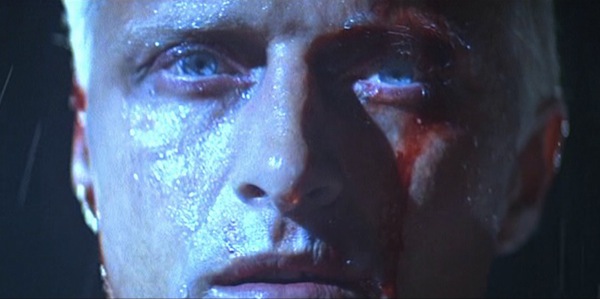
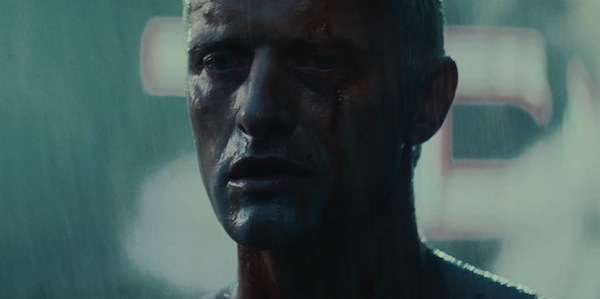
"More human than human." That is the motto of the Tyrell Corporation when designing the android replicants featured in Ridley Scott's 1982 thriller, Blade Runner. At first it is hard to believe when we see Roy Batty and his compatriots ruthlessly slaughter many people trying to seek out their creator, but as the film progresses, the rapidly deteriorating Androids show that they may indeed be more human than human. Rutger Hauer shines in this film, giving the most searingly existential performance to grace the science fiction sphere in years. The confrontation between him and Harrison Ford's Rick Deckard could very easily have been written as a cliched chase sequence, but the devastating presence of Hauer pushes the sequence into a more genuine realm. His emotional problems are essentially very human problems on a macro scale - fear of death, existential uncertainty, faith in his creator. His final "tears in the rain" monologue, a terse yet eloquent line, is achingly human in its resonance, reminding Harrison Ford's Rick Deckard that everyone fears death, whether they are human or replicant. There has never been a more human android than Roy Batty in all of science fiction.

2. C-3PO - Star Wars

If you are going to be technical about the whole "genre" thing, Star Wars is more of a Space Opera than outright science-fiction film, but I'm making a list of Androids here, and how can you leave C-3PO out of such a list? A worrying fussbudget, C-3PO is arguably the least malevolent on this list, and unquestionably the least violent. He is always just at the edge of the sidelines in the Star Wars universe, bemoaning his status as the apparently the Galaxy's unluckiest droid. Along with his non-Android counterpart R2-D2, C-3PO serves as a constant in the ever-changing Star Wars saga. In a strange way, he is the most down-to-earth person in the entire series. The man who easily deserves the lions share of credit for this character (apart from brilliant conceptual artist Ralph McQuarrie) is actor Anthony Daniels, who has diligently stuck by this character since his first movie back in 1977. He makes this role come alive every single time he graces the Star Wars universe with his presence - from the movies to the video games, to the animated TV shows, he is always sympathetic and brilliant.

1. Futura - Metropolis

What else could top this list but the first Android ever to grace the silver screen? The design of this Android from Fritz Lang€™s 1927 expressionist classic remains the most influential Android in the history of science fiction cinema - the first robot ever put on screen. As with Gort earlier in this list, even if you have not seen Metropolis, you can see the very foundations of modern science fiction in this machine of the past. Called by many different names throughout history, depending on whoever translated the captions of this silent film (the latest being Maschinenmensch, literally €œmachine-human€ in German), this mechanical woman is created by mad scientist Rotwang in order to infiltrate and gain control of the working class in this dystopian society. Changing it€™s appearance, Futura takes the place of Maria, the spiritual leader of the resistance, and proceeds to slander the real Maria's reputation through her manic behavior, leading the working class on a violent rebellion - all part of an elaborate plot from Rotwang to get revenge on the ruler of Metropolis. Futura is a triumph of brilliant production design and first rate maniacal acting from its performer Brigitte Helm. Her exaggerated physicality may be over the top by today€™s standards, but by the standards of German expressionism her performance works. She embodies the tone of the climax perfectly - all mad gesture, wide eyes, and maniacal intent. She was the original Android, and remains the very top. Like this list? Who have we missed? Let us know in the comments section below.

In this post: 
Prometheus
 
Posted On: 
Contributor
Contributor

Self-evidently a man who writes for the Internet, Robert also writes films, plays, teleplays, and short stories when he's not working on a movie set somewhere. He lives somewhere behind the Hollywood sign.