10 Most Awkward Scenes In James Bond Films
 M was putting it mildly when she called 007 a 'sexist misogynist dinosaur'- he's not terribly keen on foreigners or homosexuals either. Watching the early Bond films can be an awkward experience because they're peppered with the sort of casual bigotry you might otherwise expect from a disgraced stand-up comedian or a senile aunt. As the series went on, the production team tried to shed this politically incorrect image- and in doing so blundered into even more awkwardness. If you're in the mood for a cringe, these are the ten best/worst examples:
10. Dr No - Quarrel Fetches Bond's Shoes
What's more awkward than yelling at someone to fetch your shoes? Yelling at someone to fetch your shoes when that someone happens to be black, and you're the whitest guy in the world. Dr No is a great film because it establishes pretty much everything we still love about Bond. Bits of it seem creaky today, but it does a fairly good job of setting up the style and tone of the movies that followed. There's a sexy girl in a small bikini, an inscrutable, vaguely Asiatic villain, a car chase, some explosions and a significant allocation of one liners. It's politically incorrect, but that's part of the appeal- it's fun watching Bond shagging and hitting people at will, because none of us could get away with that in real life. Compare it to the moody Daniel Craig films and it all seems a bit of a lark. Everything except the infrequent bursts of casual racism. It should probably go without saying that 1962 was a very different time. The British Empire was in its death throes, and Jamaica would gain independence only a few months before Dr No was released. Still, old habits die hard, especially when they're born of an artificial sense of privilege. In the original novel, Bond's West Indian friend Quarrel played an important part in the narrative, prepping 007 for his infiltration of Dr No's headquarters. In the film, he plays an equally important, but considerably more demeaning, part. On arriving at the doctor's island base, Bond, not wanting to get sand in his socks, sensibly dispenses with his footwear. The next day, having hit a lull in his conversation with a semi-naked girl, Bond shoots a cursory glance at Quarrel and barks "fetch my shoes" at his long suffering associate. (around 2.20 in the video below); It's one of the most breath-taking moments of off-the-cuff bigotry ever committed to film, only made worse by Quarrel's obedient compliance. He runs off to collect said waterlogged slip-ons with nary a moment's hesitation or muttered swear word. This is sadly par for the course in a movie that never questions the racial hierarchy of Britain's Empire, even when it was slowly disintegrating. The only other black faces are barmen, waiters and extras- all of them servants in one way or another. Quite apart from the hilarious aristocratic prissiness of 007's command- coming only seconds after they've all just been shot at by a gunboat- the fact that Bond naturally expects a black man to do his bidding for him, without the hint of a please or thank-you, encapsulates in three seconds an ethos of oppression and subservience that lasted for hundreds of years. So yeah. In my head, I was like "did he just say that?"9. From Russia With Love - Bond Gets Slappy
 Apologies to Barry Nelson and David Niven, but Sean Connery is and always will be the best Bond. Unlike the actors who followed, he had the perfect balance of physicality and wit, effectively blurring the line between actor and character. Of course, in real life, Big Tam was (and may still be) a miserable penny pinching Scots git with a receding hairline- trust me, I know my own kind- but in one very awkward way he exactly mirrors his most famous role. In From Russia with Love, Bond assists in the defection of a beautiful Russian cypher clerk, Tanya. She has access to a much sought after decoding device, but she's also the bait in a trap to discredit 007's reputation. Bond, on discovering this, takes exactly the appropriate course of action to save that reputation- he slaps Tanya hard in the face. The ferocity of that crack is a striking moment of cinematic hypocrisy. For a character defined as a 'gentleman spy', Bond often acts horrifically towards women, while Tanya's hysterical reaction isn't intended to elicit audience sympathy for her- it's designed to justify Bond's assault as an essential corrective for an emotionally unstable woman. You could make the argument that Bond's behaviour in this scene is extreme and exceptional- and certainly he is portrayed as a more vulnerable character here- but then you'd be going against the views of a man who knows James Bond better than anybody. Namely, the man who played him for nine years. When interviewed by Playboy magazine in 1965, Connery advocated an open-handed slap as the perfect solution for any woman with the temerity to stand up to his overweening macho bulls**t. Nobody much cared, because it was an interview in Playboy magazine in 1965. However, there comes a time in every man's life when he must repeat the same inflammatory statement he made twenty two years earlier, only this time to one of America's most famous female newscasters. The Connery interview with Barbara Walters turned him into the patron saint of self-described women bashers, with the added effect that now every time you see him hit a fictional woman in a fictional film, you know he really bloody meant it. I'm not suggesting he literally slapped Daniella Bianchi, the actress who played Tanya, but he has literally slapped other women, and that in itself makes the scene too real for comfort. Just like the posters said, Sean Connery IS James Bond. In about the most awkward way possible.
8. Goldfinger: A 'Roll' In The Hay
 Goldfinger is the best Bond movie, but its narrative hinges on one of the most awkward plot twists in movie history. Halfway into the film, JB is aboard a plane, being transported to Goldfinger's Kentucky stud farm. Perhaps because he's just been threatened with an industrial laser, then shot in the side with a tranquiliser gun, the pilot is keen to make her passenger feel as comfortable as possible. The first thing she does is introduce herself. Her name? Pussy Galore. Honor Blackman's iconic character was very nearly renamed by the producers (presumably for fear of upsetting the millions of real life Pussy Galores all over the world), and it was only when a press report on a royal visit to the set mentioned the name that they decided to leave it intact. What's more surprising is that the character's lesbianism remains, albeit in muted form. Her rejoinder to 007- "You can turn off the charm- I'm immune"- is ambiguous enough to fly under the gaydar of a mainstream audience, but would've made sense to fans of the novel (where she leads an all-lesbian gang of bank robbers known as the Cement Mixers). A step forward for gay representation in cinema then? Possibly. Yes, possibly. If you ignore the scene where Bond forces himself on Ms Galore, then yes, that would possibly be the case. What's most jarring is that it all starts off as light-hearted fun. There's a bit of playful one-upmanship and Pussy- earlier portrayed as Bond's physical and mental equal- more than matches 007's judo skills. And then, with all the rare tact of a rape scene dumped into the middle of a family movie, Bond lunges at Pussy- "Now let's both play"- and moves in for a kiss. She struggles against him for a few seconds, but because the plot requires her to join forces with Bond, she can't resist for too long. The creepiest thing isn't the perma-smirk on Bond's face, or Pussy's pained breathing- you would expect details like that in a scene of, er, 'non-consensual' sex. No, what really gives the moment its awkward factor is the swooning orchestral music in the background, rising to a crescendo as Pussy gives into Bond's brute strength. Somehow, it doesn't quite convey the emotion of the moment. And that's odd, because usually nothing is more romantic than a sociopathic male thug sexually intimidating a gay woman. Still, at least it all ends happily enough, with Pussy renouncing Sappho and switching the lethal gas canisters that would've killed the population of Fort Knox. Hats off to the producers for portraying the complicated truths of human sexuality. And to think they nearly changed her name to Kitty Galore!
7. You Only Live Twice - Bond Is Japanese Now
 Anyone hoping for a sensitive portrayal of Japanese culture in a Bond film probably understood more about Japanese culture than they did about Bond films. The series' previous record with Asian characters is dubious to say the least. Dr No is essentially a variation of the Fu Manchu archetype, an inscrutable Chinese schemer with a (metal) finger in many (radioactive) pies, while Oddjob says nothing and enjoys having gold bars thrown at his chest (thankfully there are no scenes of him eating a cat, which Ian Fleming assumed was the Korean national dish). So it's all the more surprising that You Only Live Twice actually manages to be relatively restrained in its depiction of Japanese society, even finding time for a lengthy and almost dialogue free Shinto wedding sequence. This curiously moving scene is only hampered by the presence of Sean Connery in a Beatles wig and fake eyelids. I did choose the phrase 'relatively restrained' deliberately- this is the Bond movie where 007 has an operation to become more Japanese. Bond's assignment requires him to investigate a suspected rocket site located close to a Japanese fishing community. Rather than send in a Japanese, someone who speaks the language and can blend into a crowd, the secret service determines to pass off 007 as one of them. Luckily, Bond's disguise goes a bit further than chanting 'me so solly' anytime he passes a genuine Japanese person- it also involves 'extensive' plastic surgery. That Beatles wig, those fake eyelids, some spray tan and, er, that's it- Bond is as Japanese as Mr Yunioshi. This operation sequence is a very soft version of yellowface- the practice of white actors playing stereotyped Asian characters- teetering over into cringe territory because the most significant part of the transformation are the eyes. The history of Asian racial stereotyping is a history of people making jokes about slanting or 'slitty' eyes, and for the Bond creative team to home in on that attribute goes some way towards undoing their portrayal of a modern, metropolitan Japan. With all that said, the most awkward thing is how completely unconvincing the disguise is. Bond still towers over even the most strapping Japanese men, retains his Scots burr and looks ridiculous in the kind of bolo hat that only the fishermen of the island and enemies of Larry David wear. With eminent good sense, but zero regard for story logic, the disguise disappears completely a few scenes later.
6. The Man With The Golden Gun - A Much 'Loved' Character Returns
 Live and Let Die features some unexpectedly amusing comic relief in the hog-like shape of J W Pepper, a redneck sheriff who acts as exasperated onlooker to Bond and his pursuers during the boat chase sequence. We're not talking Christopher Guest here, but for a dumb action movie he's a funnier character than he ought to be. Behind the bluster of Clifton James' performance there's some genuinely well observed dialogue that just about lends credibility to the role. Whether anyone was clamouring for a return appearance is another thing, but someone on the production team clearly thought they were onto a winner, because a year later, the trailer for The Man with the Golden Gun proudly proclaimed 'Sheriff J W Pepper is back!' To be honest, by the time the good Sheriff rears his swinish head, The Man with the Golden Gun has already featured a midget henchman, a fake third nipple, a Bond girl hiding in a cupboard, two schoolgirl martial artists and a lady called Chu Me. After all that, it would've felt wrong not to have a loudmouth Southern cop in there somewhere. The problem is, whereas all those elements serve some kind of purpose in the narrative (yes, even Chu Me), JW does nothing to drive the plot of the movie. Minutes are spent establishing the fact that he's on holiday in Bangkok with his wife ("We're Demmycrats, Maybelle"- er, hilarious), that could've been spent on, oh, I don't know, the world's greatest secret agent being pursued by the world's deadliest hitman? What's most awkward is that the writers barely make an effort in bringing Bond and JW together. The sequence of events is as follows: Bond needs a car. Bond steals a car from a showroom. Bond just happens to steal the car that JW is in. And that's it. That's the level of complexity we're dealing with here. There's no suggestion that JW has tracked Bond down or been in any way proactive at all. No, you can forget yer story arcs and yer hero's journey- this is the best kind of screenwriting, the kind where things just happen because it's easier that way. Quite aside from the mystery of an American man trying to buy an American car during a holiday in Thailand, the most awkward thing about the ensuing chase scene is the inverse ratio between JW's usefulness as a character and the loudness of his mouth. Another few minutes later, and he leaves the film much as he entered it- making ill-advised jokes about 'pointyheads'. As he's led away by a gaggle of surly Thai police officers, presumably to the comforts of the Bangkok Hilton, you may realise that his intervention has contributed not one whit of plot development to the film, and precious few laughs into the bargain. Mercifully, we were spared a third appearance, saving us from more gems like "You're that English secret agent! From England!" and allowing 'Man with bottle' to take the title of 'most awkwardly shoehorned in comic relief character' for three bloody movies.
5. For Your Eyes Only: Mrs Thatcher
 For anyone outside the UK, this might seem an odd choice. It's the final scene in the movie, when Margaret Thatcher (played by impersonator Janet Brown) speaks to 'Bond' via telephone and congratulates him on a successful mission. The moment plays into a previously popular depiction of Thatcher as Britain's housewife-in-chief, doing the washing up and keeping her gormless husband Denis in check. However, by the time the film was released in cinemas, Thatcher was THE divisive figure in British politics. Her defiantly patriotic brand of leadership was very much in line with the series' worldview, but it seems a tad awkward to have a fictionalised Iron Lady fluffing her hair and giggling girlishly at a parrot's innuendos (probably best just to watch the movie, eh) when the real Iron Lady was presiding over unprecedented unemployment rates, race riots and industrial unrest. Possibly just as awkward, in light of her later struggle with dementia, is the fact that she thinks James Bond sounds exactly like a parrot ("Give us a kiss!"). The notion of Maggie unwittingly conversing by phone with a talkative bird sounds like some kind of mad satirical joke, but on the whole, this is a little bit of politics the series could probably have done without.
4. Octopussy: Bond Goes To Market
 Octopussy, the thirteenth Bond film, has a strangely old fashioned sensibility. The cars and gadgetry we expect are all there, but they're set against opulent Raj-era palaces, safaris and the hunt for a Fabergé egg. This is the India of 1933, not 1983, and it's mostly populated by broad ethnic stereotypes. Awkward? Undeniably, but I'll give it this- when the Bond series does ethnic stereotyping, it does it thoroughly. When Bond arrives in India, his helicopter passes the Taj Mahal. You can tell a movie isn't going to be a masterpiece of nuance when it uses an internationally recognised landmark in its first establishing shot. Touching down, the Bond meets a snake-charmer (helpfully tootling away at the Bond theme) and then a taxi driver. These two people are his MI6 contacts. They take Bond to his hotel, he wins a lot of money at the casino, and as he hands them their share of the winnings, he intones the immortal line "That should keep you in curry". If you thought the movie was going to peak at that magnificent example of casual racism, then you're adorably innocent. The creative team have plenty more clichés where that came from. Happily for impatient viewers, they dump most of them in the ensuing chase scene. On leaving the casino, Bond is attacked by a massive Indian fella wielding an elephant gun (tick). He drives off in a little Tuk Tuk taxi (tick) into a crowded marketplace (tick) populated by a camel (tick), a sword swallower (tick) and a swami on a bed of nails (tick tick tick). It's just as well they were all out and about that day, otherwise Bond would have had to tell more curry jokes to boost the screenplay's stereotype quota. The moment is awkward in two ways- firstly, for the sheer cheap laziness of the observations, and secondly, for the useless efforts to integrate them into the narrative. The chase scene has zero tension because every few seconds the camera will home in on another of these visual platitudes and wring every drop of enfeebled humour from it. Imagine one of the writers went to a stand-up club and opened their set with 'Hey, what's the deal with those funky little taxis they have in India? Huh? Y'know those taxis they have?' and nobody in the audience laughed because no insight or meaning had gone into the words. That's exactly what this moment in Octopussy is like. And it's bloody awkward.
3. A View To A Kill: An Old Man Gets Up To Naughtiness
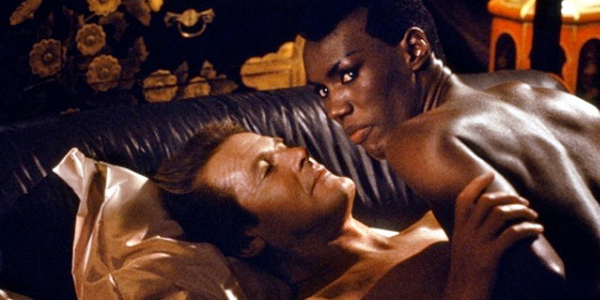
 Roger Moore was 58 when A View to a Kill was released, and he looks every inch of it. Well, every inch of a 58 year old who has had an unfortunate facelift. His leading ladies this time round were Grace Jones (37) and Tanya Roberts (30). He has twenty one years on the first and nearly thirty years on the second. To put that in perspective, he was nearly 100% older than his leading lady. If that doesn't make mathematical sense, then it makes 'it just feels wrong' sense. In his previous two Bond movies, the writers had deliberately paired Moore with more mature actresses, the better to make his own descent into senescence seem less jarring. Here, they throw up their hands and let him shag away to his dodgy heart's content. One of the qualities Moore brought to the role was his essential disbelief in the character. As he pointed out, Bond is supposed to be a spy, yet his catchphrase is his name- "Bond, James Bond" ('ah, but is it his name?' whimper the fanboys). The seduction scenes, which in Connery's firm grip were charged with sexual charisma, became elaborate and knowing jokes. They're less funny when Bond is double the age of the girl under him, leering at her with a ragged vulpine smile. This is exactly how his first conquest of the movie, an MI6 operative in an iceberg shaped mini-sub, plays out. You can see the facelift. You can hear the wheeze in his voice. It's your dad hitting on your girlfriend, and it's as erotic as crazy paving. Incredibly, it's not even the most awkward love scene in the movie. That title would have to go to the Grace Jones moment. A View to a Kill was made in 1985, so an appearance from Grace Jones was inevitable. Brilliantly, she's playing herself as she was on The Russell Harty Show- sullen, and physically abusive. Combine this with Moore's decrepit suavity and you have the least romantic chemistry ever recorded on film. The best thing is that the film-makers seem to be completely aware of it, and fashion a scenario so awkward you wouldn't wish it on your worst grand-dad. Bond, enjoying some midnight spying, is nearly discovered by the villain Zorin and his hench-lady May Day (Jones). Dragging a victory from the jaws of defeat (while simultaneously dragging defeat from the jaws of victory) he hops into May Day's bed and purrs huskily "I've been waiting for you". His next line- "You're a woman of few words"- is at least half-verifiable. There follows the most awkward disrobing ever (Grace drops her furs to reveal some eerily well-toned back muscles), the most awkward slipping into bed moment ever (literally- one second of rogue nipple was edited from the sequence) and the most awkward example in the admittedly limited range of 'flipping over then straddling a terrified old man' moments. Nothing about this sequence is right. Nothing about it should have been allowed to reach celluloid. There was no Bond fan on Earth who wanted to see Grace Jones manhandle a tired Roger Moore. There was no human being on Earth who wanted to see Grace Jones manhandle a tired Roger Moore. Awkward? This moment practically redefines the word. After that, Bond's closing contretemps with Tanya Roberts in a shower seems positively normal. It's not, of course, but a love scene with Grace Jones is always going to be the most awkward moment in anything, ever.
2. The Living Daylights: One Man's Freedom Fighters...
 Although the Bond series is one of the great cultural artefacts of the Cold War, direct flashpoints- like Vietnam- were never directly alluded to. This had been a deliberate strategy on the part of the production team- removing the politics of the Fleming novels meant that the films could be accessible to audiences across the world. The Living Daylights, the first film of the Timothy Dalton interregnum, is unusual for adopting a real life global conflict- the Soviet war in Afghanistan- as the backdrop for its storyline. This might have been an effective way of differentiating his debut from the fantasy excesses of the Roger Moore years, but it was a downright awkward way of avoiding the old 'much loved fictional character ends up colluding with a notorious terrorist group' pitfall. In the third act of the narrative, Bond is kidnapped by a Russian double agent and taken to a Soviet prison in Pinewood Studios. Luckily, he has a gas spewing watch that only activates around dopy prison guards. During his escape, he frees a raving derelict who turns out to be Kamran Shah, the Oxford educated leader of a local Mujahedeen faction. Bond presses them into action and after a lot of explosions and a nice model shot of a tank falling through a collapsing bridge, they succeed in freeing Afghanistan from the yolk of Soviet oppression. It's one of the most impressively mounted action sequences in Bond history, and acts as a fine conclusion to a pretty excellent movie. The awkwardness comes when you realise that the Mujahedeen would slowly mutate into the Taliban. Following the collapse of the Soviet Union, the Mujahedeen fell into infighting and was eventually swallowed up by the newer organisation. Although there are fundamental differences between the two movements, both are associated with the Islamic notion of jihad, not least because both were funded by a certain Mr Osama B. Laden esquire. Perhaps significantly, Bin Laden, like the Kamran Shah character in the movie, was wealthy, of good family, and privately educated. If Kamran Shah isn't meant as a direct parallel, then he was at least similar enough to provoke a little nervousness from MGM, who pulled the DVD edition of The Living Daylights from circulation for a few months post-9/11. Of course, the Bond team had no way of knowing what would happen in the intervening years and could hardly be accused of endorsing the Taliban. The most awkward thing about The Living Daylights, then, isn't anything in the movie itself (although Bond does not suit a turban). The most awkward thing is that it reminds us that one man's freedom fighters can eventually turn out to be, er, the same man's terrorists.
1. GoldenEye: Down Guantanamo Way
 Speaking of the War on Terror... In the six year hiatus that followed Timothy Dalton's second Bond movie, the Soviet Union fell, and many commentators struggled to see a place for 007 in the 'new world order' that was emerging. GoldenEye proved those critics wrong with a slick new leading man in Pierce Brosnan and a clutch of bravura action sequences, but most importantly in acknowledging the character's Cold War roots and exploring what it means to be James Bond in a world without clearly defined ideological opposites. If anything, it's the more contemporary references that have aged badly, particularly a throwaway line at the end of the movie. The scene: Bond has defeated the rogue 00 agent Alec Trevelyan by dropping a satellite array on his face. In the surrounding jungle, he's enjoying a post-ideological kiss with the sexy Russian computer programmer Natalya. It's safe to say that things could get a little shagging-orientated, but before they can, a team of Navy SEALS emerge from the undergrowth, along with Bond's oafish CIA contact Jack Wade (the fact that they waited for a bit seems slightly...well...awkward). It's here that Wade offers a line that most certainly wasn't written with posterity in mind: "Maybe you two'd like to finish debriefing each other at Guantanamo?" Er...unless he's talking about a different Guantanamo, I'm not sure if waterboarding, kneeling down with a black hood over your face, marines blasting out Metallica 24 hours a day- I'm just not sure if any of those things are really that romantic. But then, maybe Bond likes a bit of kink. Like The Living Daylights, this is another topical reference that might have seemed innocuous enough at the time, but takes on a more awkward meaning after the geopolitical craziness of the last decade and a bit. At least, after fifty years and twenty three movies, Bond hasn't lost his capacity for cringe, and in this ever changing world in which we live in...that's awkwardly comforting.