10 "Guilty Pleasure" Movies You Shouldn't Be Ashamed To Love
Finally! An article that makes it okay for you to like Mean Girls.

The term "guilty pleasure" is banded around - usually by those who take film as a medium a little more seriously than your average movie-goer - as a sort of excuse system that allows people to admit that they like something that they also think is beneath them. "It's a guilty pleasure," acts as a kind of fool-proof defense mechanism when you know that your opinion on a particular film will be unpopular with others.
And because everyone has their own guilty pleasures, we tend to let people have theirs without much discussion: the point of a guilty pleasure is that said person is acknowledging a movie is "bad," after all - what else is there to say once that's been admitted? Still, there are certain movies that you'll find are frequently sited by many as "guilty pleasures," despite the fact that there's really absolutely nothing to be ashamed of.
The following movies have somehow edged their way into guilty pleasure status, presumably because people have failed to understand their intentions, or because they can't quite figure out what it is they like about them, when in all actuality there are tons of obvious merits and brilliant positives to be appreciated. Join us, then, as we take a look at 10 guilty pleasure movies people shouldn't be ashamed to love. Movies that, when you think about it, don't deserve to be branded as guilty pleasures at all...
10. Starship Troopers (1997)

When Starship Troopers first landed in cinemas, the world at large seemed somewhat unsure what to make of it. Was it bad on purpose? Was the whole thing supposed to be a sort of joke? Given that Troopers was directed by Paul Verhoeven, the master satirist behind the likes of RoboCop, it's a bit of mystery as to why people were so confused. That's to say, for a good few years after its release, Starship Troopers was banded around as a movie that people only felt as though they could admit to liking as a "guilty pleasure" - as if the movie weren't 100% self-aware.
But lots of movie fans are still hesitant to come out of the Starship Troopers closet for fear their tastes will be brought into question, not realising that the corny quotes, cheesy costumes and sets, and downright questionable "politics" are intentional. As a result, Troopers barely qualifies as a "guilty pleasure" at all: there's nothing guilty to be associated with this movie. In fact, it's closer to something of a masterpiece than it is a guilty pleasure - a hilarious black comedy; ironic and genuinely intelligent. Does the guilty pleasure part stem from the fact that it's just so much fun?
9. Mean Girls (2004)

Most female fans have no qualms about stating their love for Mean Girls, of course, and why should they? Tina Fey's script, based on the non-fiction book "Queen Bees and Wannabes," is far smarter than it appears at first glance - the problem with this one's guilty pleasure status tends to arise from male viewers who can't seem to resist its charms. "I hate to admit it, but I like Mean Girls," is something you might hear once in a while from a frustrated male movie fan who can't put a finger on exactly why he feels that way.
Truth is, Mean Girls is both great fun and great satire. So whereas this flick has all the genetic makeup of a movie that pretty much asks us to hate it (it's a film with Lindsay Lohan set in a high school and it's called "Mean Girls") it's also one entry to the teen movie canon that managed to transcend its origins: the key to the movie's appeal is that Fey doesn't look down upon her subjects - she sends them up whilst assuring that she takes their points of view into consideration at the same time. Characters who could have been mere stereotypes are still real people. And it doesn't hurt that it's never boring for even a second.
8. Big Trouble In Little China (1986)
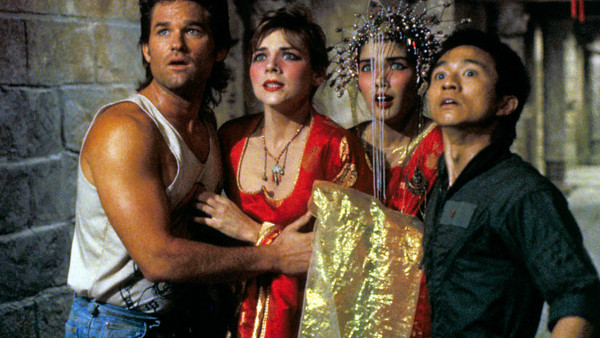
When Steven Spielberg made Raiders of the Lost Ark, he set out to play homage to the B-grade movie serials that he grew up with as a kid: pictures built around stoic, fedora-clad heroes, convoluted plots, fantastical elements, endlessly inventive set-pieces, and insane cliffhangers. Truth is, though he undoubtably conjured up a worthwhile tribute, he transcended the material to the point where he made a truly great film that only half-resembled the "lesser" aspects that the old serials embraced to no end: simply put, Raiders is too good to be written off as mere homage.
John Carpenter set out to do exactly the same thing when he made Big Trouble in Little China, and though the final movie is perhaps not quite the technical or narrative accomplishment that Raiders is, Carpenter arguably captures the manic, freewheeling spirit of the B-movie serials to a far greater extent than Spielberg ever did. Although many are quick to brandish this movie - which stars Kurt Russell as a trucker caught in an age old battle in Chinatown - as a "so bad it's good guilty pleasure," it's important to keep in mind that that was exactly the director's intention.
7. Jingle All The Way (1996)

It's easy to write off Jingle All The Way as a throwaway entry in that questionable subgenre of motion pictures we've collectively branded as "Christmas movies," perhaps because - on the surface - it appears to thrown together without care, stars Arnold Schwarzenegger and Sinbad in dual comic performances, and was directed by the otherwise calamitous Brian Levant. Look closer, though, and you'll see that Jingle All The Way sets itself apart from most Christmas movies in its willingness to actually acknowledge the holiday for what it's become: a corporate sham.
Which isn't to say that Jingle All The Way sets out to ridicule Christmas entirely - just that it isn't afraid to make light of some of its more questionable aspects. It would be wrong, then, to brand the movie - which has Schwarzenegger's frantic dad trying to find an action figure for his son in the run-up to the holiday - as a total satire, because there's a clear reason why this movie is so often branded a "guilty pleasure." But there's another reason why people shouldn't be ashamed to say that they like it; it's a funny, frantic thrill ride... and, hey, it actually has something to say!
6. Hostel (2005)

Hostel captured the attention of the masses at the time of its realise, mainly thanks to our obsession with the "torture porn" subgenre (which was at the height of its popularity back in 2005), but has become increasingly unpopular in recent years. Eli Roth's gruesome little horror flick has since been regulated to "guilty pleasure" status - admitting that you like it, whatever the reason, is bound to provoke raised eyebrows from those view it as mostly pointless. But Hostel is far more worthwhile than the naysayers would have you believe - not to mention it's a blast.
Okay, so there's no denying that there is something inherently appealing about the narrative set-up: backpackers are abducted by a shady corporation and are sold to rich people who pay to torture and kill them. Roth clearly relishes the chance to gross out his audience, but he's merely having fun - as with his underrated debut Cabin Fever - in a heightened B-movie sense. The effects aren't realistic; they're purposely pulpy - and don't forget that the movie itself is an apt and relevant critique on society's obsession with consumerism, and not "just another Saw rip-off."
5. Clueless (1995)

Clueless already gets bonus points because it's actually an updated version of Jane Austen's classic novel, Emma (the location, the names and the, uh, "costumes" were changed), which automatically helps away from "guilty movie" territory - territory that it never had much place in anyway. Given that Clueless is the cinematic equivalent of eating an entire pack of pink bubble gum in one go, then, it's no wonder that people tend to automatically assume that this sharp, funny and satirical take on '90s high school subcultures just has to be a guilty pleasure.
Clueless has recently begun to find itself reappraised by those who may have written it off as a minor effort. Truth is, it's brilliantly witty and endlessly watchable, much like Alicia Silverstone's bratty protagonist, Cher, who manages to embrace all the worst Valley Girl stereotypes and still somehow remains likeable: that Clueless manages to both critique and embrace Cher's subculture is hugely impressive. But whereas on the surface this is a movie about a spoilt teenager who likes to get her own way, it's also a soft meditation of what it means to be yourself.
4. Mars Attacks! (1996)

Mars Attacks! is perhaps the most misunderstood film in Tim Burton's ever-expanding canon, and as a result is also one of his most unpopular. After all, it doesn't have the mainstream appeal of something like Alice in Wonderland, nor does it centre on a major star like Johnny Depp to lead proceedings: what it does instead is centre on several major stars (dozens, in fact), a notion which presumably proved too much for audiences in 1996, who weren't expecting a movie so tightly-connected to its B-movie origins.
To mention a love for Mars Attacks! nowadays is risky business. It seems unfair that a movie so clearly made as a balls to the walls parody should be relegated to that of a "guilty pleasure" status - after all, every aspect of this movie that can now be supposedly enjoyed in a "guilty" way was originally intended in that way. Burton racks up one ridiculous scene after another, as Martians descend upon our planet, only to find themselves going up against the likes of Jack Nicholson, Pierce Brosnan, Michael J. Fox and - yes - Tom Jones. Remember: any movie that ends with the Tom Jones belting out "It's Not Unusual" already knows that it's guilty.
3. Love, Actually (2003)

There aren't many who will actively admit to disliking Richard Curtis' near-on gag-inducingly sentimental Christmas time romance, Love Actually - but those same people probably wouldn't be all that prepared to defend it as a great film, either. Which means that, like previous Curtis works such as Four Weddings and A Funeral and Notting Hill (both of which could have made this list for their own reasons), Love Actually is one of the most universally accepted "guilty pleasures" movies, presumably because most people like at least one of its many, many storylines.
The reason Love Actually is so often poised as a movie you should force yourself to feel guilty for watching, though, stems from the simple fact that it's so intoxicatingly unrealistic - almost as if it's a... fantasy? And therein lies the inherent problem: for once, Richard Curtis has penned a romantic comedy that near enough acknowledges itself as pure hokum (the mysterious character played by Rowan Atkinson kind of seals the deal on this front). Thus, we should be enjoying Love Actually not as something to be ingested with guilt, but as a beautiful, implausible fantasy.
2. Titanic (1997)

Though at first it might seem ridiculous to suggest that Titanic - the second-highest grossing movie of all time - is a guilty pleasure movie, a poll conducted by Time Out magazine revealed that James Cameron's epic about the sinking of the famous ship was the UK's seventh most popular flick when people were asked to vote for their personal choices. What's odd about this result is that so many people clearly like Titanic, and yet instinctively feel - in their bones, it seems - that it's a "bad movie."
Have we merely been told it's a bad movie, or does it genuinely stink? Well, no: it doesn't. Schmaltzy? Yes. Frothy to the point of irritating? Sometimes, sure. Do we want to hear Celine Dion belting "My Heart Will Go On" again for as long as we live? Absolutely not. But there's so much more to this picture aside from that of its central romance, but the constant quotes and parodies have left audiences feeling numbed by its very existence - to the point that the only way to view Titanic without guilt nowadays is to say something along the lines of, "I know it's terrible, but I love it," without ever questioning, really, whether it actually is.
1. Showgirls (1995)

What better way to salute the end of this list and the "guilty pleasure" than with another Paul Verhoeven movie whose quality and merit has been pondered over perhaps more than any other movie mentioned here? Yes, Showgirls has become notorious for its depictions of skimpily-clad women, a script that appears to have been written by an inebriated sixteen-year-old, and all the terrible acting you can throw a first year drama class at. Powered by an outrageous - and very naked - performance by Elizabeth Berkley (uh-huh: nerdy Jessie from Saved By The Bell), Showgirls is often sited as one of the worst films ever made and a staple "guilty pleasure" movie.
Had anyone else directed Showgirls, it might never have been necessary for anybody re-approach what has shown itself to be very re-approachable movie. But alas, this is a Paul Verhoeven film, and it should be viewed in as such. Because ultimately, this fierce and mean-spirited satire purposely set out to critique aspects of Hollywood filmmaking and show business itself: the movie is about the movie. That's not to say that Showgirls cannot be enjoyed on a non-intellectual level, but the very fact that people "secretly" enjoy it... well, that was the entire point. The excess - in this case, sex - is inherently appealing. So breathe it all it - totally guilt-free.
What 'guilty pleasure' movies do you love? Let us know down in the comments.