8 Things You May Have Missed About DC's Watchmen
We could've had a very different comic book.
Whether you're a comic book fan or not, it really isn't difficult to appreciate Watchmen.
Commonly cited as one of the most influential works of the 20th Century, you'd struggle to find a comic book more revered and indeed lauded than Alan Moore and Dave Gibbons' 1986 classic. And for good reason too; Moore's timeless dissection of Cold War paranoia remains one of the finest literary works of all time, and provided the medium with a cultural salience that, quite noticeably, it has since failed to reclaim.
Moore's work has given rise to plenty of imitators over the years, and while he may lament the slew of merchandising that has since followed in its wake, it's mightily impressive that the book still manages to capture the conscience of so many of its readers across so many different mediums; even if all them happen to misunderstand Rorschach, but y’know. It’s cool nonetheless.
But what about the stuff people don’t know about the book? With so many twists and turns in the path to its creation, and indeed with the license itself today, there’s a lot out there that you may have missed. And, while we may not know who watches the Watchmen, we do know who watches (reads) everything about them.
This guy.
8. Moore Originally Wanted To Use Preexisting DC Characters
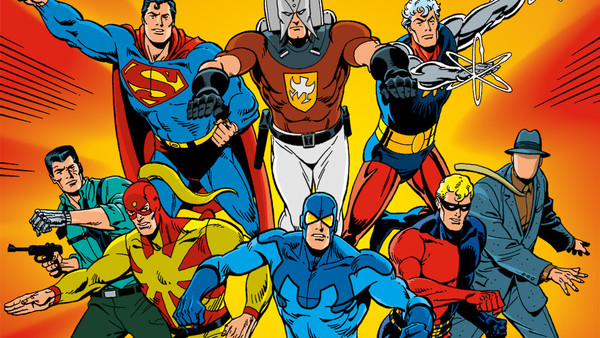
One of the most interesting things to consider in Watchmen's development is that Moore originally wanted to use characters from Charlton Comics, a company that had recently sold its properties in the summer of 1983. DC, however, had other plans for the heroes, adding them into the mainstream DCU two years later during Crisis on Infinite Earths. One such character, The Question, would even be the subject of a long-running series by Dennis O'Neil and Denys Cowan - one that reimagined the character as a sagely vigilante fighting for social justice, and less of the Steve Ditko-y, more Rorschach-y blend that had defined the original Charlton character.
Charlton's characters formed much of the template behind the Minutemen, with Nite Owl and Doctor Manhattan acting as stand-ins for Blue Beetle and Captain Atom respectively. While Silk Spectre draws many a comparison to Black Canary, the character is actually based on Nightshade, with Peacemaker and Thunderbolt also forming the basis for The Comedian and Ozymandias respectively.
Ignoring the popularity of Watchmen's characters for a second, it is an interesting prospect to consider what the book would've been like had DC given Moore permission to use the original Charlton versions of the characters. It's probably best that he wasn't however, especially since The Question and Blue Beetle went on to enjoy their own critically revered stints in the medium after the series concluded.
7. It's An Actual Comic Book In The DC Universe
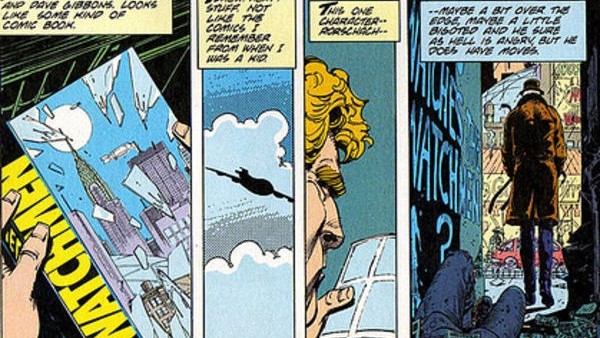
Dennis O'Neil and Denys Cowan's aforementioned run on The Question was, apart from being a quality series in every shape and form, really funny when it wanted it to be. One of its best moments came in the seventeenth issue, where Vic Sage, seemingly unoccupied on his long flight away from Hub City, picks up Watchmen at the book store, proceeds to read it, and then dreams that he was Rorschach for a moment.
The entire issue sees the character asking 'What would Rorschach do?', to the point where the faceless hero's imitations of the character leave him on the verge of getting killed. Realising this, Sage - when asked if he had any last words to give - professes that 'Rorschach sucks', which are words to live by, honestly.
Luckily Green Arrow drops by to lend Vic a hand, but it's still a funny moment to consider nonetheless. Especially when, y'know, Rorschach continues to be euologised (perhaps erroneously) to this day.
6. There Have Been Countless Attempts To Adapt The Comic

Though it might seem unlikely, given just how critically lauded the comic book actually is, Watchmen had a hard time making its way to the big screen. In fact, several attempts were made to adapt the comic before Zack Snyder succeeded in 2009, with Darren Aronofsky having even been involved in a plan to bring it to cinemas (he later departed another comic project, The Wolverine, in 2011).
Starting in 1986, Fox enlisted screenwriter Sam Hamm to write a screenplay and, although it departed from the book's ending in a significant way, the project began to gather steam. Terry Gilliam was attached to direct, and, after significant rewrites, even wanted Arnold (yes, that Arnold) for the part of Doctor Manhattan. And yes, before you ask, we are all equally gutted that this never saw the light of day as well.
Subsequent attempts to make the film were made in the early 2000s, with the aforementioned Aronofsky project stalling around 2005 with a script provided by David Hayter. Paul Greengrass (of The Bourne Supremacy/Ultimatum fame) was also contracted to direct, but dropped out over budgetary concerns, leaving us with Snyder's film in 2009, which offered a beat for beat adaptation of the source material.
As for future projects, Warner Bros. Animation are currently working on an animated film, and just recently HBO have announced a Watchmen TV series. Neither, obviously, have received Moore's blessing.
5. Vietnam Became The 51st State

What would life be like if America emerged victorious in Vietnam?
It's an interesting thought to consider, not least because it would have fundamentally altered the course of the country during the 1970s, a decade most associate with the its ostensible decline under presidents Nixon, Ford, and Carter.
It's a reality the world of Watchmen occupies, however, with the Comedian having instigated the Gulf of Tonkin incident (echoing familiar conspiracy theories surrounding the events of the USA's entry into the conflict) - a course that propelled President Johnson to authorise the deployment of Doctor Manhattan that would later ensure the defeat of Ho Chi Minh's forces. The defeat resulted in the United States absorbing Vietnam as its 51st state, although with that level of imperialism ruling the Watchmen White House, you have to wonder why others didn't follow.
As far as alternate histories go, this one hast to be among the most interesting.
4. There Was A Massive Prequel Event In 2012

Though the purists of the series will likely lament the mere mention of Before Watchmen (why though?), DC's 2012 event is worth noting for several reasons - one of them being that, y'know, some of the minis were actually quite good. Gasp!
The late, great Darwyn Cooke started things off with a mini recounting the release of Hollis Mason's autobiography, 'Under the Hood'. In it, Cooke explores Mason's days as the original Nite Owl during the forties, and his art - as always - retained its wonderful style. Other series, such as the ones that focussed on Ozymandias and Doctor Manhattan, were also critically well received, although the rest released to a mixed reception.
There's a tonne to unpick in the 2012 event, and while some are happy with the OG novel and nothing else, exploring the world that Moore and Gibbons created with a different voice to guide you is a great opportunity, and a surefire way of extending your stay in the Watchmen mythos.
3. Dr. Manhattan Is Currently Messing With DC's Multiverse

Given how Doctor Manhattan is basically a god, with the whole omniscient and omnipotent thing about him, it was only a matter of time until he ended up screwing with the fabric of reality. Seeing as how Watchmen is a DC property, and how all DC properties are encompassed in the Multiverse (of which Grant Morrison has prepared a handy guide for, bless), it makes sense. And, given how DC are killing it when it comes to the whole comic book thing at the mo', there's plenty of cause to be excited.
We'll find out just how exactly Manhattan has been playing with reality in Doomsday Clock, the brainchild of perennial DC writer, Geoff Johns. It's shaping up to once again shake the DCU up in a big way, promising smart social commentary, cool linkups between the characters of both worlds, and the expansion of the Rebirth-ethos that has typified DC's approach to storytelling since May last year.
It'll certainly be interesting to see Moore and Gibbons' characters interacting with the denizens of the DCU, especially if they get to see their original Charlton selves along the way. It's an ambitious (some would say cynical) use of the license, but we'll see how things pan out when it releases this November.
2. There's Really No Wrong Way To Read Its Ending

Ozymandias was, in the main Watchmen timeline, the world's smartest man. He had brains. Lot's of them.
And so, he came to the conclusion that the only way humanity could ever save itself from nuclear catastrophe would be if a threat large enough - and lethal enough - caused the world's leaders to cooperate (think Independence Day, but with significantly less Bill Pullman, and you're about halfway there). This of course leads to Veidt's infamous squid monster, and, most damagingly of all, the murder of The Comedian. All, as the Sanford saying goes, for the greater good.
Rorschach, unwilling to compromise in the face of armageddon, leaves to expose Veidt's plans. The rest of the group, however (including the omniscient Doctor Manhattan), see Veidt's logic, and - before ol' Walt can escape - Manhattan tragically incinerates him. The real tragedy of this murder, however, is that Manhattan himself cares not to disclose the future to his comrades. Imparting one last statement to Ozymandias, he reminds him that, as is often the case with history, "nothing ever ends."
One can only speculate whether Veidt lived to see the peace he created last, but it's an interesting prospect to consider nonetheless, especially if it turned out that Rorschach's journal was printed en masse - a consequence that would have surely ensured the failure of his plans. That is, unless anyone would even believe the ramblings of a disgraced vigilante in the first place.
Sigh, why does this book's ending have to be so tragic?
1. It's The Only Comic Book In Time's Finest Novels Of All Time

Granted it's printed on every copy of the graphic novel, but still, you probably didn't know that it was the only comic book to feature on the list.
It speaks largely to the salience of the series that Moore and Gibbons were able to leave such a legacy behind. To this day, comic books are still getting a bum rap, despite the fact they're as artistic and engaging as any novel is. Granted, there are plenty of issues to be had with the medium, but to decry visual storytelling as being fundamentally puerile or egregious isn't just intellectually dishonest, but plain wrong in itself. Indeed, as Watchmen displayed - and indeed continues to display - the medium as a whole has the potential to defy expectation, and tell stories worth telling.
Alan Moore and Dave Gibbons' novel continues to form the benchmark that all other books strive to reach, and, while none have surpassed it in terms of critical or commercial clout, the medium continues to produce content that could beat most of the stuff on our bookshelves by a country mile. There's obviously a reason why Watchmen deserved a spot on the greatest novels of the century, so who's to say that another comic book is out of contention to take one in the future?
Ultimately, Watchmen managed to reinvent what a comic book could achieve, and for that reason alone, it's more than deserving of its place on Time's roster.
-
Learn anything new about the Watchmen mythos? Is there a fact out there that we've missed? Prefer The Question over Rorschach? Let us know in the comments below!