8 Comics That Almost Had Better Endings
Yes, believe it or not, the Clone Saga could've been amazing.

Typically, when a comic book series, graphic novel, or book comes to an end, they have a solid conclusion. The characters and their storylines are all tied up in a nice, neat package, and the fans can go on to read something else, but every so often, other endings were written, but never used.
This happens all the time in movies, and thanks to the internet, it's not hard to find alternate endings to films like Scott Pilgrim vs. The World, Blade, Avengers: Age of Ultron, and more. Of course, movies based on comics are one thing, but comic books are something else entirely.
After all, they take a considerable amount of time to create, so when the artist takes their pen to paper, it's usually the final step, and while some pages may be swapped out for others, the ending tends to stand. Still, there are occasions where something changes between concept and creation, which necessitate moving in a different direction.
The comic books with alternate endings or endings that were never illustrated tend to live in a world of rumor before being confirmed, and often, the fans can't help but wonder if a series would have ended better had the creators stuck with their original plan.
8. Batman: A Death In The Family

One of the most impactful comic book stories to tear down Batman's world was 1989's "Batman: A Death in the Family." The story took place in Batman #426 through #429, and it told the tale of Jason Todd's quest to find his birth mother after Batman relieved him of his job as Robin.
While he's on his quest, he's kidnapped by the Joker, who tortures and kills the Boy Wonder. The death of Jason Todd rocked Batman's world, and it's something he never truly recovered from. When the books were published, they came with two 900 numbers fans could call and vote on Todd's fate.
One number would give a vote for Jason Todd's survival while the other would end in his death. More than 10,000 votes were cast during the 36 hours the lines were open on September 15, 1988, and lo and behold, Jason Todd earned a thumbs down from the fans (but not without some allegations of cheating).
The ending came with Batman holding the beaten and battered corpse of Jason Todd, but due to the fact that the vote could have gone either way, an alternate ending was also created. In the alternate ending, Batman was holding Todd's body, but he exclaims, "HE'S ALIVE!" Doubtless, some fans would have been happy with that outcome while others wouldn't, so whether or not it's better is different for every reader.
7. Dragon Ball

The original Dragon Ball series was written and illustrated by Akira Toriyama from 1984 until 1995 in the pages of Weekly Shōnen Jump. By the time Toriyama concluded the series, it has been told in 519 individual chapters, which were collected into 42 tankōbon volumes, making for a particularly long manga.
The series spawned an anime, and with it, a media franchise was born, but by 1995, Toriyama was ready to move on. He had worked on it consistently — with few breaks — for more than a decade, and he had other projects he wanted to get to, so the 519th chapter was his last.
While the ending wasn't bad, there were a number of fans who felt that it was rushed, and didn't close up some of the characters in a way they would have liked. Fortunately, Toriyama wrote a second ending, but the world didn't find out about it until the 2000s when Dragon Ball Kanzeban (Perfect Edition) was released.
The ending was altered for the Kanzeban to include the original narrative Toriiyama wrote nearly a decade before, but with some tweaks. In it, Goku passes the torch to Uub, as he did originally, but the new ending also passed over the Nimbus Cloud. This was a callback to Goku's origin when he was a child, and it tied the series together perfectly.
6. The Dark Phoenix Saga

One of the biggest and most impactful events to sweep across the Marvel Universe was the Dark Phoenix Saga. In it, Jean Grey is overtaken by the Phoenix Force, and her powers exponentially increase to the levels of a god. She destroyed a star and wreaked havoc across the cosmos.
In the end, she sacrificed her own life to remove the threat she had become, and that ending proved controversial, as it removed Jean Grey from the X-Men books... for a while anyway. The original ending was much different than the one that was ultimately published in X-Men #137.
Originally, the X-Men were all defeated and were taken aboard a Shi'Ar vessel. While there, Jean was subjected to a machine that removed her powers, and once it was finished, she and the rest of the X-Men were permitted to leave. The last five pages had to be completely redrawn to what was ultimately published.
Killing Jean Grey created the first true "event" in comics history, and seeing as publishers have been trying to one-up the Death of Phoenix storyline, it would probably have been better for everyone had she been permitted to live. In the end, Jim Shooter insisted she die, and that's the ending Marvel published.
5. The Walking Dead
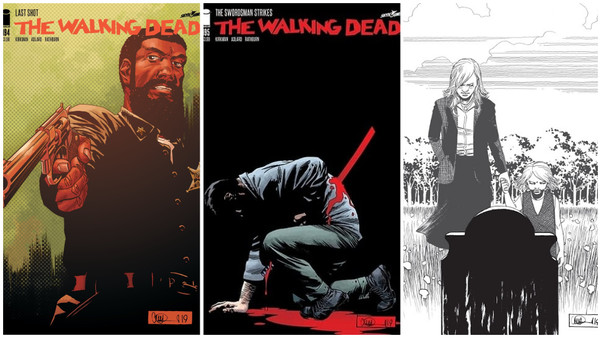
Robert Kirkman's The Walking Dead was one of the most successful independent comics ever produced, and with the books came a franchise worth millions. While the comics and the television series veered off from one another as AMC's The Walking Dead continued, the books came to abrupt ending with issue #193.
Not only was this an odd number to conclude a decade-spanning series like The Walking Dead, but it was a complete and total surprise to everybody. Kirkman may have been one of the few people to know his highly popular and critically-acclaimed book was coming to an end and that's why it arrives on this list.
To be clear, Kirkman brought the book to a natural conclusion in the way he wanted to, so there wasn't another ending the writer was planning on using but didn't. That said, he could have fooled his fans, but more importantly, he did fool comic book stores.
While there was no alternate ending scripted, Kirkman had several fake covers drawn up for issues 194 through 196 despite the fact that they were never coming out. From those covers, a reader could take away what the narrative might have been, so in a way, there was an alternate ending to The Walking Dead, and seeing as a lot of fans weren't happy with the way the books ended, many would argue the extension towards issue #200 would have been preferred.
4. New Gods

Jack Kirby's New Gods series is arguably one of the King's greatest works for DC. He introduced numerous cosmic elements previously unseen in the DC Universe, and his creation of Darkseid and the characters associated with him, have influenced the development of Superman and many of his allies in the Justice League.
Unfortunately, the series was ahead of its time, and as a result, it didn't find a wide audience when it was released. Comics historian Les Daniels described it as "Kirby's mix of slang and myth, science fiction and the Bible, made for a heady brew." As a result, DC canceled it after only 11 issues.
The early cancelation meant that Kirby was unable to give his series the ending he originally planned, which makes any ending better than the one fans got in 1972. Fans were left wondering what happened in the ongoing conflict between New Genesis and Apokolips, as that remained unresolved.
Kirby's original plan was to upend and destroy the Fourth World he created. The New Gods were meant to die, which would have fulfilled the Darkseid/Orion prophecy. Ultimately, DC kept the characters alive, so Kirby's Fourth World never ended as he would have truly liked.
3. The Clone Saga

One of the most hated events in Spider-Man history came in the Clone Saga, which ran from October 1994 until December 1996. There were aspects of the storyline that were ingenious, and they called back to stories from the early 1970s, but in the end, it was a convoluted mess.
The story became confusing, and with too many changes, which indicated Spider-Man wasn't the real SPiedy but was instead a clone. That ended up being changed at the end, and when it was all said and done, Spider-Man fans were happy to get back to normal, but it didn't have to be that way.
Originally, the Clone Saga was meant to run the course of a year and would serve to replace Peter Parker with Ben Reilly. This was met with a lot of controversy, but it would have created a story arc with a beginning, middle, and ending. Instead, it became a confusing and complex nightmare for fans.
Marvel's micromanager-in-chief, Bob Harras, saw the sales figures and pushed the writers and artists to extend the story for three years. That undercut the intended structure of the story and pushed it beyond what was originally planned. Had the story been told as it was intended, it would doubtless hold a better place in Spider-Man history than it does today.
2. Crisis On Infinite Earths

One of the biggest events to hit the DC Universe was 1985's Crisis on Infinite Earths. The story was created by Marv Wolfman, who felt the DC Universe needed some tweaking, as its Multiverse and broken continuity over the previous 50 years made it confusing and difficult to follow.
Wolfman's pitch was taken almost exactly as he hoped, but in the end, the editors forced him to use a completely different ending. Originally, Wolfman had wanted to end Crisis with the rebirth of the Earth. This would then be followed by the characters' rebirth as well.
He wanted the books to restart at issue #1, and then he and other creators working for DC at the time would then restart everything. The Flash and Supergirl wouldn't be dead because they, along with everyone else, would get rebooted to their first issue, and everything would start over from the beginning.
DC's EIC, Dick Giordano, didn't believe the company had the talent needed to make that happen, so he and the editors responsible for the books didn't go down that route. Wolfman spoke about the changes to the ending in an interview with Dan Greenfield:
"And I was told that the editors didn’t like that because if the heroes didn’t remember all their stories, it would invalidate everything that had existed previously, to which I answered with extreme sarcasm, “Our heroes do not buy our comic books. (Laughter) The fans do and they will still have all those books on their bookshelf and they will remember all those things.”"
1. Laika
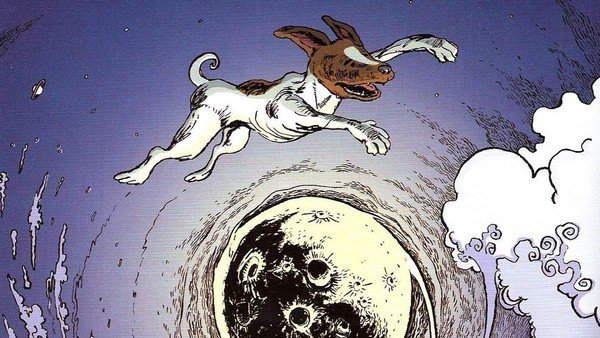
In 2007, Nick Abadzis published his graphic novel, Laika, about a stray dog who became the first Earthing to reach space via the Soviet Union's Space Program. Parts of the story are told from the dog's perspective, and the story follows the real-life events surrounding Laika's trek into space.
That's unfortunate because, while Laika was the first Earthling to leave the planet's atmosphere, she was also the first Earthling to die in space. The graphic novel manages to tell Laika's story, but its evocative imagery left many readers saddened by what happened to her.
Fortunately, Abadzis was paying attention, and in an effort to quell his readers' sadness, he created a series of alternate endings to his book, which were arguably much happier than the one he originally told.
It's come to my attention over the years since my book LAIKA was published by First Second in 2007 that the ending upset a lot of readers. The truth is, even if they've never heard of this little book, anyone who's heard of Laika has googled her and found out how her story ends. But somehow, we wish we could change it. We wish we could change the way things happened by writing about them.
In the alternate endings, Laika parachutes to Earth and survives, she is adopted by a loving family and is recognized as a national hero, she plays out the ending of 2001: A Space Odyssey, and she becomes a superhero following exposure to cosmic rays!
Watch Next
Only A True Believer Can Identify All Of These Spider-Man Characters
