10 Marvel Characters Shamelessly Ripped Off From DC Comics
Shameless comic book yoinking.

DC has been playing catch-up to Marvel at the movies for years now, but when both firms first entered the comic sector many decades ago, the reverse was true. Detective Comics published its first issue way back in 1937, giving it a significant head start on Marvel, which began life as Timely Comics five years later.
The House of M had ground to make up on its rival and one of the ways it has narrowed the gulf is considered underhanded by some. Several of the firm's creations bear an uncanny resemblance to characters that already existed in the DC camp.
Marvel is by no means the only comic book publisher guilty of this practise. The industry has always been rife with copycats and imitators, and with so much history to trawl through, it's often difficult to pinpoint who came up who an idea first.
Sure, there have been times when DC has ripped off Marvel. Namor predates Aquaman and Bumblebee is basically a second-rate Wasp, but some of the most high-profile examples of this dubious practise paint Marvel as the house of stolen ideas...
10. Thanos Is A Rip-Off Of Darkseid

When DC Comics introduced a cosmic beefcake that posed a threat to its entire universe in 1970, Marvel Comics needed one too, and sure enough, along came Thanos three years later, in all of his Darkseid-inspired glory.
Thanos's creator Jim Starlin has addressed the blatant similarities between the two characters over the years and explained how he never set out to emulate Darkseid. The Mad Titan was originally inspired by another of DC's New Gods, Metron.
When Starlin presented his sketches to then-Marvel editor Roy Thomas, he was told to return to the drawing board and rip off Darkseid instead of Metron, a meeting he spoke candidly about in an interview with Jon B. Cooke for Comic Book Artist.
"Beef him up! If you're going to steal one of the New Gods, at least rip off Darkseid, the really good one!"
That seems like shrewd, if somewhat unethical advice from Thomas, because the success of Thanos has seen him become one of the most anticipated movie villains of the modern age ahead of his full MCU debut in next year's Avengers: Infinity War.
9. Hawkeye Was Marvel's Answer To Green Arrow

Most comic book ripoffs aren't quite as blatant as the Thanos-Darkseid case. Often one publisher will put their own spin on an existing creation and change the character just enough to avoid an expensive lawsuit, and that was how Hawkeye was born.
DC Comics introduced its own master archer in 1941's More Fun Comics #73 when Oliver Queen made his arrow-slinging debut, while Clint Barton didn't make his first appearance until Tales of Suspense #57 in 1964.
The similarities between the two characters are undeniable. Both are sharpshooters whose weapon of choice is a bow and arrow, and they're each partial to tech enhancements. The pair also went on to become key members in their publisher's superhero team, the Justice League and the Avengers, respectively.
The success of Green Arrow is no doubt what inspired Marvel to put out a rival character, but in all fairness, they put a unique spin on the concept by making their version a master assassin and introducing him as a villain initially.
Plus let's not forget that Green Arrow wasn't exactly earth-shatteringly original to begin with. He's basically an amalgamation of Robin Hood and DC's own Batman.
8. Black Cat Is Marvel's Catwoman

It's obvious what Marvel's intention was when it introduced Black Cat to its comic book universe in 1979's Amazing Spider-Man #194: the publisher wanted a younger, sexier version of DC's Catwoman, who made her debut almost four decades earlier.
Extra cleavage and an age gap are the only differences between Felicia Hardy and Selina Kyle. Both characters boast identical skills, use the same equipment (grappling hooks and retractable claws) and occasionally fight on the same side as the heroes.
Black Cat and Catwoman are also known to share the odd kiss with the series hero, Spider-Man and Batman, respectively, and are underpinned by moral shades of grey.
Over time, Felicia has acquired new abilities to set her apart, like super strength and 'bad luck' powers, but her origins are rooted in copycat practises.
7. Deadpool Was Blatantly Based On Deathstroke

Deadpool was ripped off from Deathstroke so blatantly that it's become a running joke in the comics industry that both sides are in on, and have referenced numerous times.
Wade Wilson was created by artist Rob Liefeld 11 years after DC's Terminator made his first appearance in a 1980 issue of Teen Titans.
The illustrator presented a sketch of the character that looked like it could have been traced from an image of Deathstroke to writer Fabian Nicieza. The scribe felt the similarities between the two were so glaringly obvious that it was worth proceeding for the controversy alone. Naming the character Slade Wilson was the cherry on top.
Not only is Deadpool basically a pallet-swapped version of his DC counterpart, he has many of the same abilities and a near-identical character arc that saw him debut as a villain before becoming more of an anti-hero.
Over time, Deadpool has taken on a life of his own and become a walking, talking satire of the comic book industry, something that translated exceptionally well to cinema when he made his solo movie debut in 2016.
6. Quicksilver Was A Quick Fix That Gave Marvel Its Flash
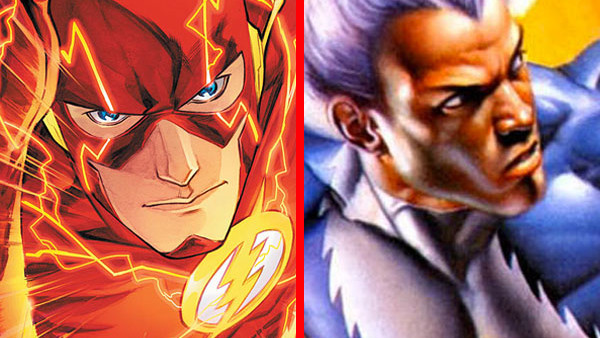
The only thing surprising about Marvel launching a Flash knockoff in 1964 is that it took them 24 years to do it. Although DC debuted its first speedster in 1940's Flash Comics #1, two and a half decades was more than enough time to come up with a derivative just different enough to avoid a suing.
Quicksilver raced onto the scene in X-Men #4, rocking all of the same powers at The Flash. The only key difference was how he got them.
DC's Flash was struck by lightning while Pietro Maximoff's speedy abilities are the result of his mutant origins as the son of Magneto. That's pretty big difference, but Marvel's intention was clearly to create a rival character.
To drive home the point that Quicksilver is about as unoriginal as they come, there was another non-Marvel character with exactly the same name who debuted in Quality Comics' National Comics #5 in 1940. He went on to become DC's Max Mercury.
5. Vision Bears An Uncanny Resemblance To Red Tornado
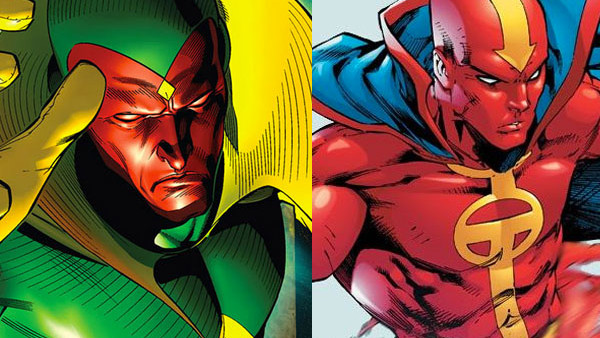
Vision was created by a villain to destroy the Avengers in 1968. Five years earlier, DC introduced a character called Red Tornado under suspiciously similar circumstances.
Red Tornado first appeared in 1963 as an enemy of Justice Society of America, but one twist later, he was fighting alongside the heroes as a full member of the team.
Like Vision, he's an android created as a result of a merger between more than one entity, but that's not even the biggest similarity the characters' share. Their resemblance from a visual standpoint is uncanny, give or take a different colour pallet.
To be fair, Vision and Red Tornado have different powers and personalities which have developed over the decades, but the design similarities cannot be overlooked.
4. Justice League Was Assembled Before The Avengers

DC Comics precursor National Periodical Publications popularised the concept of superhero team-ups in 1960 when it assembled the Justice League on the pages of The Brave and the Bold #28.
The success of the union forced Marvel to come up with a rival title, with the company's owner Martin Goodman asking then-editor Stan Lee to assemble a league of their own. Lee has recounted what came next in his autobiography...
"Martin mentioned that he had noticed one of the titles published by National Comics seemed to be selling better than most. It was a book called The Justice League of America and it was composed of a team of superheroes. 'If the Justice League is selling ', spoke he, 'why don't we put out a comic book that features a team of superheroes?'"
Marvel's initial weapon in the battle against the Justice League was the Fantastic Four, but it wasn't until 1963 that the firm took the fight to its rival by forming The Avengers.
It's funny how the companies' cinematic universes have mirrored their strategies in the comic book sector, except in reverse. Marvel brought the Avengers to the big screen long before DC got a Justice League movie off the ground, and its competitor has been playing catch-up on this front ever since.
3. Boomerang Is A Captain Boomerang Ripoff... For Some Reason

Exactly why Marvel wanted to ripoff one of DC's goofiest characters remains a mystery, but that's exactly what it did in 1966 when it hurled Boomerang at unsuspecting readers.
The villain, who made his debut in Tales to Astonish #81is essentially a reskinned version of Flash villain Captain Boomerang. Both characters are Australian and have few special skills beyond tossing gimmicked boomerangs around. Case closed.
Marvel's Boomerang has gone on to become a recurrent Spider-Man foe and a mainstay in the Thunderbolts, remaining a part of the villainous team when it became the Dark Avengers.
Perhaps Marvel's intention was to one-up DC by launching an even goofier boomerang-tossing villain. They won that round by placing a daft boomerang-shaped mask on his face. Well played, Marvel.
2. Gladiator Is Basically Superman

Gladiator is a super-powered being whose abilities include flight, enhanced strength, super hearing, heat vision and ice breath. Remind you of anyone?
Just in case anyone mistakingly thought this Marvel character wasn't a complete ripoff of Superman, creators Chris Claremont and Dave Cockrum had him hail from an alien planet and gave him the alias of Kallark (a combination of Supes' Earth and Kryptonian names).
Gladiator debuted in 1977's Uncanny X-Men #107, and has since appeared in numerous X titles, as well as the likes of Fantastic Four, Rom the Spaceknight, Silver Surfer, Nova, and New Warriors.
So, how did Marvel get away with this unabashed act of plagiarism? By claiming Gladiator was a homage, of course. Not to Superman per se, but the 1930 Philip Wylie novel Gladiator, which Supes was partially based on.
1. Deadshot Was Clearly The Inspiration For Bullseye

DC's Deadshot and Marvel's Bullseye are two sharpshooters from troubled background who never miss their targets. The only real difference between them is that the former debuted 26 years before the Daredevil villain.
When DC pitted their skilled marksman against Batman in 1950, it worked so well that Marvel decided to pose a similar threat to its dark, street-level hero Daredevil in 1976.
The two villains share another thing in common: they've both been butchered on the big screen, Deadshot by Will Smith and Bullseye by Colin Farrell, but it's a Marvel property that can claim to have done that first.
Of course, there are differences between the characters besides their choice of costume. Chief among them is that Deadshot has dabbled in anti-heroism on occasion, while Bullseye is an out-and-out villain.