With the 3D re-release for the 20th anniversary of Steven Spielberg's original 1993 classic earlier this year, there has finally been some real development on a potential fourth Jurassic Park film. In March, Safety Not Guaranteed's Colin Trevorrow was confirmed as the new film's director, rewriting a script from Rise of the Planet of the Apes' Rick Jaffa and Amanda Silver. Last month a release date was finally confirmed, June 12th 2015, and a new name: Jurassic World. Jurassic World already has its first cast member, Bryce Dallas Howard, but who else will be joining the former Gwen Stacy to make this a movie that can plausibly compete against 2015's other big hitters? Fans of the original would be happy to see Jeff Goldblum's chaotician Ian Malcolm back for more, while it might be interesting to see Joseph Mazzello (paleontology geek kid and human piece of toast Tim) return now he's grown up. The Social Network star has worked on a Spielberg production since, World War 2 miniseries The Pacific, so would be a much more likely bet to return than screen sister Ariana Richards, who is now a painter. Realistically, though, when it comes to seeing stars return for another Jurassic installment, there are only two names that are likely to come up again and again: Velociraptor and Tyrannosaurus Rex. Similarly, when it comes to speculating about new cast members, the likes of Richie Cunningham's daughter don't really cut it. It's all about the dinosaurs. So, here are ten potential stars from the world of prehistoric reptiles that have yet to appear in a Jurassic Park film.
10. Tanystropheus
This freakish looking creature is literally half neck. It's entire body was 20 feet long, but 10 feet of that was its neck. Despite its giant size, paleontologists think that this Triassic beast could detach its tail if caught by a predator and then regrow it later like some small lizards today. Tanystropheus ate small fish and insects, so wouldn't exactly be a threat to Jurassic World's humans, but this slightly odd animal, who lived both on land and in the water, would make an interestingly unusual background creature to populate the dino world. Generally suspected to have been quite a poor swimmer, Tanystropheus would, instead, have walked along the bottom of the sea, using its incredibly long neck to catch its prey. None of the Jurassic Park films thus far have spent much time in water, possibly due to the complications it creates with producing good effects, so this fourth installment has that as a whole new area to explore. A creature like Tanystropheus could lead nicely from land animals to undersea ones as an early introduction, if the film is looking to bring in some sea monsters at some point.
9. Stygimoloch
As well as the beasties that could rip you in two while you sit on the toilet, Jurassic Park has also given us a fairly wide variety of herbivorous dinosaurs. Pachycephalosaurids, the dinosaurs with the big, thick, domed skulls, made a brief appearance in sequel The Lost World, but not in this particular species. Stygimoloch is the most interesting looking of the Pachycephalosaurs. Its name roughly translates as "demon from the river of hell" (although geeky fans may prefer the related Dracorex hogwartsia, "dragon king of Hogwarts"). While a "veggiesaurus", Stygimoloch's skull, covered in spines and horns, gives it an impressively monstrous demonic look that would be fun to see as part of Jurassic World. Although we don't really know what these hard heads were for, the general feeling is that they were likely to be used for head-butting, ramming themselves together head on like goats today. Again, these are not necessarily dinosaurs that could provide a direct threat to our human heroes, although they would probably want to get out of the way of one when it was charging. This is more likely to be a creature that is met early on and impresses us and the characters with the recreated dinosaur world on offer, like the Stegosaurs in The Lost World.
8. Giganotosaurus
For many, the T-Rex was the hero of the original Jurassic Park. The scene that introduces her through the ripples in the cup of water very quickly entered the pop cultural lexicon and when she did appear she looked amazing. The effects, both animatronic and CGI did not disappoint. Spielberg, too, clearly realised the T-Rex was the star by having her come and save the day at the end. In the third movie, though, a need to up the ante saw director Joe Johnston introduce a rival huge carnivore as the new movie's new star. The dinosaur chosen, Spinosaurus, may have been an even larger beast than the Tyrannosaur, but the fish eating creature never seemed the same kind of physical threat. Possibly this is just due to its shape, that long, thin mouth and teeth not quite a match for T-Rex's huge head and massive razor teeth. Giganotosaurus (often mistakenly spelled "Gigantosaurus") offers a creature that is similar to a Tyrannosaur, a fellow Carcharodontosaurid dinosaur, but one that, at comfortably over 40 feet in length, may have been even bigger than Jurassic Park's biggest carnivore. A Tyrannosaur vs. Giganotosaur battle would be fun to watch, but it's possible that both dinosaurs look a little too similar for people to tell them apart. Not properly discovered until 1993, the year the first movie came out, Giganatosaurus would be a good way to reference animals that were unknown at that time, albeit one that doesn't quite fit with the idea that these were first cloned in the early 90s.
7. Majungasaurus
Majungasaurs were about 20 feet long, which places them as a predator whose size is in the middle between T-Rex and Velociraptor. Jurassic Park hasn't yet really bothered with these mid-level predators, so the introduction of one here would be a bit of a change in pace. It's an animal that's still significantly bigger than a human and would have no trouble attacking one, without being such a giant monster as the Tyrannosaur. This Madagascan carnivore seems to have fed largely on the enormous sauropods, the biggest of all dinosaurs, so it would make a good scene to see one try and bring down a much bigger animal. When it comes to what makes a creepy monster, however, the real appeal of Majungasaurus is that it is one of the very few dinosaurs known to have been a cannibal. Very little is likely to creep an audience out more about an animal than the sight of it happily devouring its own kind. Perhaps this could be incorporated as one the early problems that the scientists putting together the park had failed to foresee: when Majungasaurs were put in their own enclosure away from other dinosaurs, they preferred to eat each other than the sheep and cattle the park apparently feed the dinosaurs.
6. Argentinosaurus
If you're thinking about having a creature that hunts and feeds on massive sauropods, then it's probably worth having a few of those as well. One of the most memorable scenes in the original Jurassic Park is the moment when the group of scientists that have been brought to the island realise that they are there to witness real live dinosaurs. As John Williams' epic score soars into the movie's theme, a giant Brachiosaur reaches up to the branches of the trees above them. It was a moment of wonder for both characters and audience, the first dinosaur they had seen. While trying completely to recreate that moment in a new Jurassic film would probably never quite work the same way, it would be appealing at least to reference this scene. If "bigger means better" is the mantra by which sequels choose to operate, then Argentinosaurus fits the bill perfectly. Arguably the biggest dinosaur of them all (there'll always be some debate on that), it was an even grander creature even than the first movie's Brachiosaur, over 100 feet long and weighing upwards of 80 tonnes. If Jurassic World wants to set out its stall as a movie of bigger scale than the previous three, it could certainly do worse than introducing this Cretaceous giant early on.
5. Juravenator
At the opposite end of the size spectrum from Argentinosaurus, Juravenator was one of the smallest dinosaurs at only about 2.5 feet in length. One of the ways Jurassic World can top its predecessors is not necessarily in going with the bigger scale creatures, but also the very, very small. When the novels were first written and the films made, Compsognathids were the smallest known dinosaurs. Discoveries over the last twenty years have meant that this is no longer the case. Jurassic World could reflect that with some truly tiny dinosaurs like Juravenator. Initially thought to be a relative of Compsognathus, paleontologists now think that Juravenator is more closely related to the raptors. The one fossil specimen that exists shows an animal with both extensive scales and some simple feathers, so that would be a way to acknowledge the increasing likelihood that many dinosaurs were feathered whilst keeping them mostly scaly (something like the feathery crests the Velociraptors were given for Jurassic Park III). In the novels Procompsognathus dinosaurs were used as the park's waste disposal system, running freely around eating the dung of the bigger dinosaurs. That they had managed to breed and get off the island is the first sign that something is wrong. Although small, they preyed on children, the infirm and elderly. In the film of The Lost World Compsognathus was used to similar effect in one scene, but the films haven't got much use out of little dinosaurs. A small predator and scavenger would, once again, give Jurassic World a little more variety of scale.
4. Sinornithosaurus
On the subject of feathers and dinosaurs, Sinornithosaurus, the "Chinese bird lizard", have been found with fossilised impressions of feathers all over its body, including longer bird-like feathers around their legs. Essentially this meant that Sinornithosaurus had what amounted to wings, allowing it to glide long distances. Sinornithosaurus is a member of the Dromaeosaurid family, what we would colloquially think of as "raptors", that contains Velociraptor and Deinonychus, the dinosaur the movie Raptors more closely resemble. The inclusion of a different sort of "raptor" that was smaller and more feathered could be a nice way of the movie acknowledging that its version of the Velociraptor doesn't really correspond with what scientist these days think, without actually changing the iconic look of the movie Velociraptor itself. At about 3 feet in length, Sinornithosaurus are quite a bit smaller even than a real Velociraptor, but their ability to climb and glide would give them an extra dimension. What makes Sinornithosaurus a really good candidate for a Jurassic movie, though, is the thing that Dilophosaurus brought as the third predator in the first movie: poison. It's still a subject of fierce debate amongst paleontologists, but popular enough as an idea to work in fiction, but the cavities in Sinornithosaurus' jaw and the grooves in its teeth suggest that they had a venomous bite. Definitely an element that would be good to see in Jurassic World.
3. Utahraptor
While there has been criticism of how Jurassic Park's Velociraptors don't reflect the birdlike nature of the animals as we now understand them, it's worth remembering that, back in 1993, it was one of the first sources really to popularise the notion that dinosaurs were just prehistoric birds. Big and featherless though they may have been, the movie Velociraptors were repeatedly used to suggest that they were birds at heart. At the time of the film's production and release much bigger raptors were being uncovered and researched. Spielberg's funding of paleontological research even resulted in calls suggesting the new species go by the name Utahraptor spielbergi. Probably no tribute to the new generation of dino discoveries in the last two decades could be better than giving Jurassic World bigger, meaner, more birdlike raptors like these. Utahraptors were about 23 feet long, three or four times the size of Velociraptor, with those famous curved tearing claws on their second toes over 9 inches long. Anybody who doesn't want to see a raptor the size of a grizzly bear probably isn't part of Jurassic World's main target audience.
2. Troodon
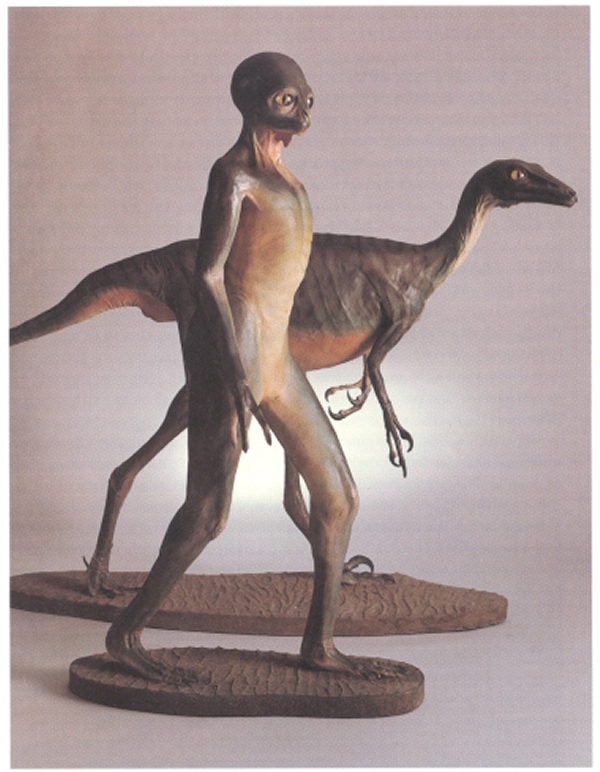
Some of you may remember some of the proposed concept art for a truly bizarre earlier Jurassic Park IV pitch that had humanoid dinosaurs being engineered as super soldiers. This image, however, is not one of those. That was created by a real paleontologist to suggest an evolutionary path that dinosaurs might have experienced had they not gone extinct. It was designed by the fossil curator of the National Museum of Canada in 1982, years before Michael Crichton sat down to write the first Jurassic Park. Since then a number of people have questioned quite how human it looks, but the point remains that the dinosaur it is supposed to be descended from, Troodon, is generally felt to have been the brainiest of dinosaurs. If Jurassic World wants a smart hunter capable of challenging their Velociraptor through brains rather than brawn, then Troodon is the obvious choice. A fast mover with excellent eyesight, they would be pretty hard for any human to escape from and, if they caught you, they share the raptors' sickle shaped claw to tear people apart. On top of all that, Troodon's "hands" were far more able to grasp and even hold some objects than other dinosaurs. If any dino's going to figure out opening doors, it's likely to be this one.
1. Liopleurodon
The final entry on this list is not, technically, a dinosaur at all, but remains the creature Jurassic Park fans would like to see above all others. One of the few elements that did really work about Jurassic Park III was the movie expanding its horizons to incorporate other prehistoric reptiles from other environments. The sequence with the aviary and a group of Pteranodons was actually inspired by a similar sequence in Crichton's first book, but in being repositioned into the third film it managed to lift what was otherwise quite repetitive dinosaur attack material. If Trevorrow and his writers are looking for a similarly new environment for Jurassic World then underwater would be perfect. If the island has an aviary, then why not an aquarium? Given producer Spielberg's background as the pioneer of the marine monster movie with Jaws, an undersea segment would seem likely with early speculation suggesting essentially a Jurassic Sea World where sharks are fed to giant marine reptiles. The first entry on this list mentioned utilising an aquatic setting and there are a number of options if Trevorrow wants to populate a marine Jurassic Park, from Icthyosaurs to Plesiosaurs. It is Liopleurodon that is the choice of most viewers thanks to its memorable appearance in both the BBC's Walking With Dinosaurs and ITV's Primeval. It may not be quite the 80 foot monster Walking With Dinosaurs suggested, but with massive jaws of 10 feet alone it's still a giant that could swallow a swimmer whole. And what do you think? Respond in the comments with the prehistoric monsters that would reinvigorate this once extinct franchise for you.