A notable come-down from the brilliance of The Empire Strikes Back, Return Of The Jedi is an altogether middling experience, replete with fine moments but overall lacking in the emotional heft and dramatic richness of the franchise's superior films. Always my favourite of the originals as a kid (a consensus shared, in my experience, by many), Jedi has left me more disappointed than most in this rewatch series, the previous entries of which can be found here. No doubt hampered by my own high-expectations, the film nevertheless has issues beyond my personal ones, and it remains that the long stretch on Endor, which I'll talk more about later, is one of the most misjudged stretches of any blockbuster ever. However, in keeping with the rest of this series, I've tried to be more positive than negative, attempting to analyse the Star Wars saga from the standpoint of a viewer who hasn't watched them since he was a teenager. Thus, it must be said, that Return Of The Jedi is a fine film in its own right. We've come full circle on the saga (for now), and what's been made most evident is the incredible narrative symmetry Lucas and his varying teams have depicted, which is indeed continued here. Add to that the usual stunning tableaux (which we've come to see Star Wars is brimming with), and an end duel which gave fans everything they'd ever wanted from the Vader/Luke dynamic, and you get a fitting finale to the greatest pop-culture institution since The Beatles. Honourable Mention: Leia's gold bikini, which I didn't want to "Lad Bible" by dedicating a whole section to but which nevertheless needs mentioning. It's supernova-hot.Dis-honourable Mention: The Ewoks, which I didn't want to dedicate a whole section to because they've been bashed enough but which nevertheless remain one of the greatest WTFs in cinema history. Cute, though.
8. Luke's Entrance Was Worth The Wait
Star Wars fans had waited a long time to see Luke Skywalker in full on Jedi-mode, and his entrance here, which pretty much begins the long, protracted sequence at Jabba's palace, finally delivered on the saga's promise to turn Luke into the most powerful warrior in the universe. It's a great entrance, the huge door to Hutt Castle slowly opening to let in a growing band of blinding light. Through the light walks a hooded figure - looking, it has to be said, like a Sith lord; a great bit of possible foreshadowing - stalking methodically down the entrance way. Then we see him, and it's Luke, who in another eerie moment of Sith paralleling, chokes two of Jabba's pathetic guards with a simple wave of his hands. Next, using the Jedi mind tricks he was so awed by when Obi-Wan used them in A New Hope, Luke persuades the hapless Bib Fortuna to grant him an audience with Jabba. Such magic fails to work on the slug himself, but the way Luke speaks to him - all talk of death and destruction should the Hutt not release Han Solo - is rife with allusions to Luke's mastery of his powers (it's also worth noting that Luke's tone resounds as far more Dark Side than it does otherwise). This is Skywalker as we've wanted to see him since Obi-Wan first spoke of the Jedi two films ago, and rewatching Return Of The Jedi reminds one that his entrance is just as powerful (if not quite as iconic) as Darth Vader's in that very film.
7. And Mark Hamill Puts In His Best Performance As Luke
Put against the gravitas of Alec Guinness or the charisma of Harrison Ford, Mark Hamill was always going to suffer. Far from being bad in the original Star Wars trilogy, the actor is instead simply outshone, especially so when you consider that the series is never going to be known for its acting, ensuring that star turns such as Guinness' or Ford's are amplified. But, with Guinness gone and Ford's Han Solo relegated to a nothing role on Endor (surely one of the great butcherings of a major character in any franchise ever), Hamill is free to take centre stage. He had his own battles to fight in the Empire Strikes Back , but while the actor is fine in those instances, it remains that he is outweighed by the emotional, epic sweep of the narrative. Not so in Return Of The Jedi. The general weakness of the film's thematic heft allows for a greater emphasis on Hamill's own progression as Luke, and if he's cool and calm in his aforementioned entrance, then he's equally so in the sequence leading up to his final battle with Vader (the Emperor scenes that go on for far too long but which nevertheless show Hamill in complete control of his character). By the close of the film, Skywalker has restored balanced to the Force, and Hamill, in turn, has restored balance to his role as him, evening out his general shakiness in A New Hope to finish the series with a measured performance.
6. The Scene Above The Sarlacc Pit Is Hit-And-Miss
I'd always remembered this as one of my favourite Star Wars action scenes; a rampant, packed sequence with a number of series-best-moments contenders. Rewatching Return Of The Jedi reinforced that notion only partially, ending up as a more hit-and-miss affair. Exciting, yes, but also a bit of a let down. On the one hand, there's Luke's first use of his green lightsaber, an awe-inspiring moment for any Star Wars fan. On the other, there's Boba Fett's tame-to-say-the-least death, knocked into the Khetanna (Jabba's sail barge) accidentally by Han for one of the saga's very worst kills. Yes, there's Luke and Leia recreating their swing from A New Hope, but there's also the constant pratfalling of C-3PO. Overall, the scene retains some of its thrill, but it'll likely remain a pale imitation of the one that you remember.
5. The Scenes On Endor Are Insipid
The forest setting of Endor could've made for a great backdrop to the seemingly endless sequences set on the moon planet. With dense foliage and the stark green and brown of the woods, Return Of The Jedi could've had a great battle setting, the antithesis to the blitzed wasteland of Hoth, one more akin to Vietnam than it was to any kind of star war. Instead, the scenes on the planet feature, in no particular order, a band of teddy bears; a lacklustre assault on a shield generator which sees Han fool a Stormtrooper by literally tapping him on the shoulder; death by rocks; and a long, drawn-out, nigh on unbearable sequence in which said teddy bears mistake C-3PO for a deity, leading to minute upon minute of supposedly hilarious cultural misunderstanding. It's one of the most misjudged sequences in the whole series, and that it makes up for the bulk of the final (at the time) entry in the saga is all the more baffling. Add to that the fact that Han Solo, one of cinema's great characters, is reduced to playing a bitpart in it all (at one point "hot-wiring" a door), and the fact that C-3PO ends up reciting a Star Wars greatest hits to the Ewoks (in which he describes the events of A New Hope and The Empire Strikes Back; proof of how dramatically thin Return of the Jedi is), and you have that rare example of an entry in this Star Wars rewatch series which has forced me to be completely and utterly negative*. *Note: for the most part I've tried to keep this series positive, to try and understand and appreciate the whole saga despite its flaws; in this case, however, I had to revert to outright admonishment.
4. But The Battle Above It Is Spectacular
On the flip-side, however, is the battle above Endor, which is inter-cut with the aforementioned shenanigans on the planet and the Luke/Vader/Emperor scenes on the Death Star 2.0 (the editing of all three is finely handled, by the way). Immaculately captured in the image above, the sky is the most littered with action it had ever been at that point in the franchise (it would later be matched by the opening aerial battle of Revenge Of The Sith), and this remains the greatest space battle in the saga, taking the original one from A New Hope and turning it up to eleven. Immortalised by the meme-worthy (if you're into that sort of thing) Admiral Ackbar line, "It's a trap!", the scene serves as a thrilling respite from whatever is happening on Endor, and one only wishes that more time was spent in the sky than it was in the forest.
3. The Luke Versus Vader Sequence Is Poignant
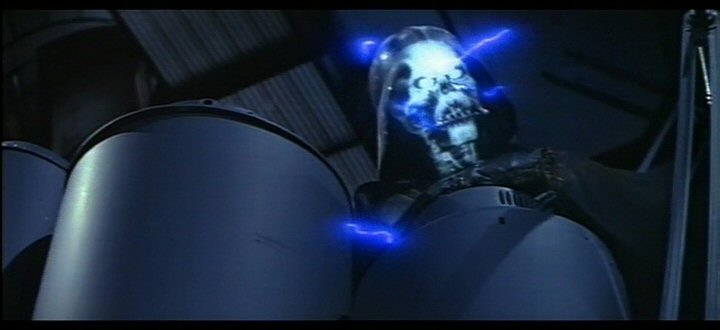
The lead-up to the actual grudge match is a little tedious, but, once we get there, it's a sight to behold (and an emotional one, too). No longer Jedi vs. Sith, Luke/Vader 2 is father vs. son, the green good of Luke's lightsaber clanging against the blood-red of Vader's in a battle neither really wants to win. It's the most outright vicious lightsaber battle in the original trilogy, and it's capped off by one of the series' great shots: the electric skull scorched onto Vader's mask as he sees the light (pun partially intended) and sends the Emperor to his vertiginous demise (though, again, Lucas' obsession with nearly ruining great moments by having a character scream "NOOO!" is present if you can't access the original cuts, this time added to the scene for the 2011 re-release). It's what comes after this which is most memorable, though, and it lends the scene its poignancy: after saving his son, Vader is embraced by Luke, who is in turn instructed to remove his father's helmet. It will kill him, but, "just for once", Vader wants to look on Luke "with his own eyes". In an instant Darth Vader is no longer; returned, moments before death, to being Anakin Skywalker, Luke's father, a good man corrupted by the Dark side but allowed back into the Light as he acquiesces to the dying of it.
2. Overall This Is A Massive Step Down From The Empire Strikes Back
It may not seem fair to compare two completely different films (The Empire Strikes Back is a sweeping tragedy; Return Of The Jedi feels much more like a remedy to that), but the drop in quality from The Empire Strikes Back to here is inescapable. If Empire is The Godfather Part II, a vast, sprawling opus, then Return is Part III, a fine but ultimately inferior film, one bereft of the narrative weight which renders Empire so bleakly prophetic. Directed by the relatively unknown, Richard Marquand (himself taking over from the relatively unknown Irvin Kershner), Return Of The Jedi retains Lawrence Kasdan as a screenwriter, the sometime-director again sharing screenplay credits with creator George Lucas. But what the film loses is its sense of the ebb and flow of the saga's woebegone history. Yes, the finale was always going to have to end on a more heroic tone (though as we'll see next, that can now be called into question), and yes, it delivers a full-circle, satisfying ending, but it lacks the pathos en route, seems hurtled towards the Luke/Vader grudge match. It doesn't feel as earned as it does in The Empire Strikes Back; it's inevitable, but not as tragically so.
1. The Happy Ending Is Suspect In Light Of The Force Awakens
If it wasn't for the knowledge of The Force Awakens' imminent arrival, the dénouement of Return of the Jedi would be one of the happiest of all time: balance has been brought to the Force; Han and Leia are partying, in love; the Force Ghosts are together; and Luke, after burning the last remnants of Vader, looks over to see his father join Obi-Wan and Yoda, not as the Sith Lord, but as Anakin Skywalker. For over three decades this ending, this party-scene, has been the Star Wars end note, a confirmation that the light beat out the dark; that good, cliché as it sounds, triumphed over evil. There was loss along the way, but these last scenes helped to end the original trilogy in a way which rendered the ultimate tragedy of the series (and, as I've argued throughout these articles, Star Wars is primarily a tragedy) as a means to an end, the rain before the rainbow. But, with what we know about The Force Awakens and all its possible allusions, the ending of Return Of The Jedi becomes a little more subdued, and a sense of disquiet drapes itself over the proceedings. The music is muted, the dancing ceases, the party, whilst not quite stopping, slows down a bit. If Star Wars has taught us anything, it's that the past is only prologue, and endings, happy or not, are rarely absolute. Did you enjoy this recap series? Which Star Wars movie have you most enjoyed rewatching? Share your thoughts on the whole saga (so far) down in the comments.