10 Scariest Uses Of Make-Up In Horror Movies
Feast your eyes on the most terrifying and unforgettable uses of make-up in horror films.
Fear is one of our most subjective and flexible emotions; what one person finds horrifying, another may find humorous, and we’re often afraid of different things depending on our age. Therefore, there are numerous ways that horror films can try to rattle viewers, such as by placing them in terrifying situations, challenging their sense of ethics and reality, or merely jolting them with a good jump scare.
Yet, the easiest way to do it is with striking make-up effects. Be they early examples like 1910's Frankenstein and 1922's Nosferatu, or recent shockers like this year’s Colored Out of Space and Relic, countless pieces of cinema have gotten our hearts racing with unsettling practical imagery both grotesque and subtle. Even if every other element falls short, one or two alarming depictions can be enough to make a movie memorable.
Of course, some films do it better than others, as the following ten selections prove. Whether chosen for their continual chills or one-off moments of visual fright, these entries—however obvious—undoubtedly pack portrayals that are pure nightmare fuel. (So, be sure to have the lights on as you read.)
10. Sarah Attacks Suzy – Suspiria (1977)
When it comes to combining vibrant colour schemes, hip prog rock soundtracks, enigmatic plots, and outrageous acts of violence, few did it better than Giallo master Dario Argento. 1977’s Suspiria is perhaps the best example of that.
The cryptic tale of an America ballet student named Suzy uncovering a coven of witches at a German school, this first part of Argento’s “Three Mothers” trilogy is full of dreadful imagery with dire implications. That said, it’s the final appearance of Suzy’s classmate Sarah that truly alarms.
Earlier in the film, Sarah sneaked out of her room to investigate strange noises in the hallway, leading to an unseen force chasing her into a room full of razor wire. For much of the remaining runtime, her fate is left unknown—that is, until she reappears bloodied and brandishing a butcher’s knife meant to stop Suzy from discovering the head witch, Helena Markos.
It’s the realism and simplicity of Sarah’s appearance that makes it so startling. Rather than be covered in many layers of monstrous prosthetics, her inhuman glare and few facial slashes—coupled with her demonic cackle—are enough to send shivers down the viewer’s spine. It’s as iconic as it is distressing.
9. Marty Rips Off His Face – Poltergeist (1982)
With films like The Texas Chainsaw Massacre, Jaws, and Close Encounters of the Third Kind, Tobe Hooper and Steven Spielberg had already proved capable of creating abject fear and/or heart-warming family wonder. Thus, it’s no surprise that their 1982 collaboration, Poltergeist (about the ethereal abduction of a young girl named Carol Anne Freeling), succeeded equally at both.
Released a couple of years before the MPAA initiated its PG-13 rating in America, Poltergeist is rightly considered the scariest PG movie ever made. Be it brother Robbie’s possessed clown doll or the unearthed cadavers that eventually surround matriarch Diane, it’s full of creepy sights. Even so, it’s the brief but horrendous hallucination of paranormal investigator Marty that takes the cake.
On his first night in their home, Marty sees an uncooked steak grow maggots and move across the countertop. Sickened, he rushes to vomit into the bathroom sink, cueing the burning lights to cause blisters on his face. From there, director Hooper alternates between shots of gore falling into the sink and of Marty clawing flesh and tendons from his skeleton. Sure, it's clearly a prop, but that doesn’t stop the intense and primitive flashes from making your own skin crawl, too.
8. Palmer Transforms – The Thing (1982)
John Carpenter’s adaption of John W. Campbell’s 1938 novella Who Goes There? still houses some of the greatest characters, suspense, and practical effects in modern horror.
The tale of a research crew marooned in Antarctica with a creature that replicates other organisms, its acting and direction are tough to beat. Obviously, just as much credit is owed to special effects supervisor Rob Bottin, whose myriad inventions—like a dog splitting apart and a detached head sprouting spider-like legs—even led the late film critic Roger Ebert to declare The Thing “a great barf-bag movie”.
In terms of sheer terror, however, no other moment can rival the transformation of Palmer during the infamous blood test scene. Tied to a chair alongside teammates Childs and Garry, Palmer watches calmly as self-appointed leader MacReady holds a hot piece of copper to samples of each man’s red life-force. Once he tests Palmer’s contribution, it shrieks in pain, causing MacReady to drop it. Then, Palmer begins flailing as the other men scramble to get away from him; before long, his body melts into a mesh of tentacles and teeth, resulting in one of the most petrifying body horror conversions of the decade.
7. Anna Skinned Alive – Martyrs (2008)
Pascal Laugier’s Martyrs is among the most beautifully brutal entries in the 21st Century New French Extremism movement. Although the first two-thirds or so—during which a woman named Lucie tracks down and then murders a seemingly affable couple (and their children) for the various tortures she endured as their child prisoner fifteen years prior—are disconcerting, it’s the latter portion of the film that’s hardest to stomach.
In-between finishing her mission and committing suicide, Lucie called her friend Anna to come over and help clean up the evidence. Sadly, members of the secret society to whom the couple belonged also show up and ultimately imprison Anna in the basement, with their leader—Mademoiselle—explaining that Anna’s suffering will produce transcendental glimpses into the beyond.
What follows is utterly unbearable: Anna’s body and spirit are repeatedly broken down in one instance of abuse after another. Shortly thereafter, she’s almost unrecognizable, yet still not completely gone. To push her over the edge, her captors skin her alive, with only her face retaining any flesh. That consequent grotesqueness, matched with the look of awe-struck abandonment on Anna’s face, is an emotionally harrowing snapshot of human depravity that’s impossible to forget.
6. Barlow Revealed – Salem’s Lot (1979)
Horror legend Tobe Hooper appears once more on this list, with his 1979 TV adaption of Stephen King’s second novel, Salem’s Lot, doing justice to the vampiric shocks of its inspiration. In fact, there are many exemplary moments to pick from, such as English teacher Mathew Burke encountering the undead Mike Ryerson or—perhaps more famously—precocious youth Mark Petrie seeing his schoolmate Danny Glick floating outside his bedroom, beckoning him to open the window.
Nevertheless, it’s the final form of the mysterious Kurt Barlow that stands out. The Count Dracula of the story, Barlow remains hidden for most of the tale, with his business partner (and human slave) Richard Straker appearing in public. Once too many intolerable and mysterious things happen around the town, protagonist Ben Mears joins with Petrie and a few other men to take down Barlow for good.
Wise to their plan, Barlow goes on the offensive, attacking people whilst revealing an updated variation on the Nosferatu template that includes pale blue skin, glowing yellow/red eyes, and snarling fangs. It’s remarkably effective given the production restraints, and it still ranks highly when pitted against other cinematic realizations of King’s creatures.
5. Pennywise Chews On Georgie’s Arm – It (2017)
There’s no denying the impact of Tim Curry’s performance as Pennywise in 1990’s It miniseries; however, Bill Skarsgård’s recent take on the character is exponentially more macabre and commendable, particularly in 2017’s It. With a mixture of practical effects and CGI, Skarsgård’s portrayal offers several worthwhile bits of atrocious over-the-top theatrics. Despite all of those suspenseful flare-ups, though, it’s Pennywise’s most unassuming appearance—hiding in the bushes and chewing on Georgie’s arm as Mike Hanlon gets assaulted by Henry Bowers’ racist gang—that lingers longest in our memory.
It’s a very brief scene, yes, and not especially elaborate; but, there’s just something about the morbid, open-mouthed expression on Pennywise’s face when Mike first notices him that’s wholly disturbing. Even worse is the close-up of Pennywise gleefully waving the severed arm at Mike, with his blood-soaked grin and glittery gaze displaying ominous playfulness. It’s as if he’s saying to Mike (and to the audience) that he’s omnipresent and all-powerful, so you never know when he’ll pop up again to amuse himself with more prey. Plus, the fact that he’s held on to Georgie’s arm for all of this time adds more malice to his message.
4. David’s Woodland Dream – An American Werewolf In London
Before he made 1981’s An American Werewolf In London, John Landis shot and/or penned two of the most acclaimed comedies of the era: National Lampoon’s Animal House and The Blues Brothers. Unsurprisingly, then, his first legitimate foray into horror (not counting 1973’s Schlock) also packed plenty of laughs, making it a seminal fusion of the two genres. Naturally, legendary make-up artist Rick Baker provides horrifying accentuations throughout, capitalizing fully on hero David Kessler’s turn from bull-headed American tourist into vicious werewolf.
Undoubtedly, it’s his post-werewolf attack woodland jump scare that outdoes the rest, as understated as it is. While recovering in hospital, David dreams that he’s nude and moving around a misty forest. After mauling a deer and running away fully clothed, he sees himself in the distance, laying in bed while his nurse (and love interest), Alex, tends to him.
Suddenly, the camera cuts to a close-up of David bearing large fangs and yellow eyes. It only lasts a couple of seconds, but its unanticipated and stark contrast to his usual demeanour is downright appalling. It’s no wonder why Landis and Baker reteamed two years later for Michael Jackson’s landmark Thriller music video.
3. Freddy Chases Tina – A Nightmare On Elm Street
Around the time of 1987’s A Nightmare on Elm Street 3: Dream Warriors, nocturnal slasher Freddy Kreuger’s quippy personality began to outshine his menacing potential.
That’s not necessarily a bad thing, but it did mean that it became increasingly easy to forget just how threatening and eerie he was in the first two films. In particular, Wes Craven’s 1984 original presented Kreuger as a relentlessly ghoulish figure hellbent on toying with—and then brutalizing—his victims. No other sequence demonstrates that better than his proper introduction to the audience (alongside the ill-fated friend of protagonist Nancy Thompson, Tina Gray).
After falling asleep post-coitus at a party, Tina dreams that she’s walking around her blue-tinted neighbourhood at night. It’s already a surreal and atmospheric environment, and it only gets spookier once Krueger walks toward her with elongated arms and an exaggerated smile. He’s already a dismaying presence, but the creepiest section comes about a minute later, when he taunts Tina by cutting his fingers off and laughing. It’s a look of malevolent joy that gets more troubling the longer you stare at it, and it’s the perfect indication of just how delightfully deadly Craven’s creation can be.
2. Mia – Evil Dead (2013)
Fede Alvarez certainly had his work cut out for him in remaking Sam Raimi’s 1981 classic The Evil Dead, not only in terms of doing justice to the original film but in justifying its own existence, too.
Thankfully, his vision exceeded expectations, eschewing virtually all of its forebearer’s beloved campiness in favour of a surprisingly sleek and unnerving approach. Although the entire cast makes for unforgettable Deadites, it’s the multi-part conversion of tragic heroine Mia that results in such a viscerally daunting sight.
Shortly after arriving at the cabin to detox from heroin, Mia gets startled and flees by stealing her brother’s car. It’s not long before she crashes, encounters a demonic doppelganger, and is sexually assaulted by a wicked force.
Upon returning, she burns herself in the shower and vomits all over her friend Olivia, which gets her locked in the cellar. As her injuries get worse, so too does her look, culminating in several heart-stopping flashes of a possessed Mia taunting her brother’s girlfriend, Natalie, through the cellar door. Her elation—shown via rotting skin, devilish contact lens, and gore-filled smirks—is as fun as it is frightening.
1. Regan MacNeil – The Exorcist
Often emulated but never equalled, William Friedkin’s adaption of William Peter Blatty’s novel has been lauded as “the scariest film of all time” for nearly fifty years. Despite the myriad advancements in technology that’ve given Hollywood new ways to horrify viewers since then, The Exorcist has never been beaten. In fact, the arc of Linda Blair’s Regan MacNeil—from angelic preteen to evil incarnate—is so iconic and unsettling that the title alone evokes chills.
Of course, Regan’s levitation and head-spinning scenes are the top two examples for why that is. Yet, there isn’t a second that she’s on screen that’s not distressing once she completely transforms. Although the genre has fashioned more outrageous monsters over the years, there’s just something psychologically and/or instinctually that makes Regan’s green irises, slashed cheeks, pale skin, and tattered hair coalesce into the superlative use of scary make-up in horror. (The scariest image of all, sometimes nicknamed “Regan’s High School Yearbook Photo,” isn’t even from the official film!)
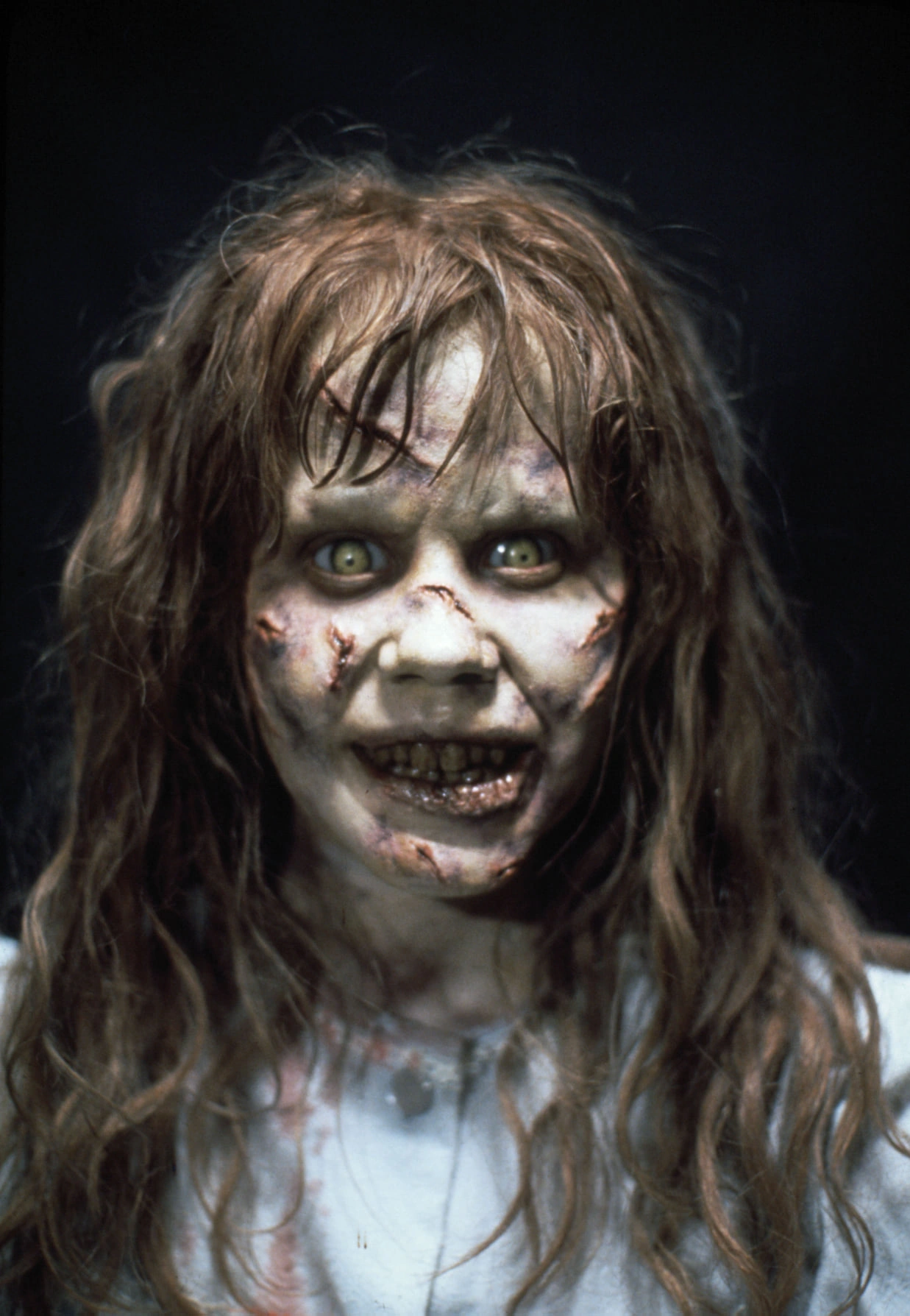
Let’s just be glad that the famous “spider-walk” scene ends where it does in the film, as the book version—where she proceeds to chase people for a bit—is too terrifying to imagine.